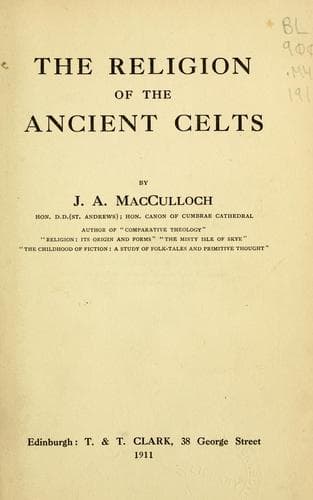
The Religion of the Ancient CeltsMacCulloch, J. A. (John Arnott)
Religion
The Religion of the Ancient Celts
MacCulloch, J. A. (John Arnott)
Celts -- Religion; Mythology, Celtic
The world of the dead was in all respects a _replica_ of this world, but
it was happier. In existing Breton and Irish belief--a survival of the
older conception of the bodily state of the dead--they resume their
tools, crafts, and occupations, and they preserve their old feelings.
Hence, when they appear on earth, it is in bodily form and in their
customary dress. Like the pagan Gauls, the Breton remembers unpaid
debts, and cannot rest till they are paid, and in Brittany, Ireland, and
the Highlands the food and clothes given to the poor after a death, feed
and clothe the dead in the other world.[1185] If the world of the dead
was subterranean,--a theory supported by current folk-belief,[1186]--the
Earth-goddess or the Earth-god, who had been first the earth itself,
then a being living below its surface and causing fertility, could not
have become the divinity of the dead until the multitude of single
graves or barrows, in each of which the dead lived, had become a wide
subterranean region of the dead. This divinity was the source of life
and growth; hence he or she was regarded as the progenitor of mankind,
who had come forth from the underworld and would return there at death.
It is not impossible that the Breton conception of Ankou, death
personified, is a reminiscence of the Celtic Dispater. He watches over
all things beyond the grave, and carries off the dead to his kingdom.
But if so he has been altered for the worse by mediæval ideas of "Death
the skeleton".[1187] He is a grisly god of death, whereas the Celtic Dis
was a beneficent god of the dead who enjoyed a happy immortality. They
were not cold phantasms, but alive and endowed with corporeal form and
able to enjoy the things of a better existence, and clad in the
beautiful raiment and gaudy ornaments which were loved so much on earth.
Hence Celtic warriors did not fear death, and suicide was extremely
common, while Spanish Celts sang hymns in praise of death, and others
celebrated the birth of men with mourning, but their deaths with
joy.[1188] Lucan's words are thus the truest expression of Celtic
eschatology--"In another region the spirit animates the members; death,
if your lore be true, is but the passage to enduring life."
Public-domain text, read in full here on John Shaqi.
Reviews
Reviews
No reviews yet
Be the first to share your thoughts on this work.
Elsewhere in the archive
Join the Discussion
Join the discussion
Sign in to leave a comment or review.
Sign InorCreate an account