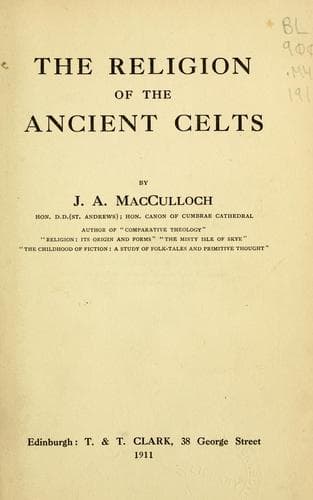
The Religion of the Ancient CeltsMacCulloch, J. A. (John Arnott)
Religion
The Religion of the Ancient Celts
MacCulloch, J. A. (John Arnott)
Celts -- Religion; Mythology, Celtic
The analogy of religious evolution in other faiths helps us in
reconstructing that of the Celts. Though no historic Celtic group was
racially pure, the profound influence of the Celtic temperament soon
"Celticised" the religious contributions of the non-Celtic element which
may already have had many Celtic parallels. Because a given Celtic rite
or belief seems to be "un-Aryan," it need not necessarily be borrowed.
The Celts had a savage past, and, conservative as they were, they kept
much of it alive. Our business, therefore, lies with Celtic religion as
a whole. These primitive elements were there before the Celts migrated
from the old "Aryan" home; yet since they appear in Celtic religion to
the end, we speak of them as Celtic. The earliest aspect of that
religion, before the Celts became a separate people, was a cult of
nature spirits, or of the life manifested in nature. But men and women
probably had separate cults, and, of the two, perhaps that of the latter
is more important. As hunters, men worshipped the animals they slew,
apologising to them for the slaughter. This apologetic attitude, found
with all primitive hunters, is of the nature of a cult. Other animals,
too sacred to be slain, would be preserved and worshipped, the cult
giving rise to domestication and pastoral life, with totemism as a
probable factor. Earth, producing vegetation, was the fruitful mother;
but since the origin of agriculture is mainly due to women, the Earth
cult would be practised by them, as well as, later, that of vegetation
and corn spirits, all regarded as female. As men began to interest
themselves in agriculture, they would join in the female cults, probably
with the result of changing the sex of the spirits worshipped. An
Earth-god would take the place of the Earth-mother, or stand as her
consort or son. Vegetation and corn spirits would often become male,
though many spirits, even when they were exalted into divinities,
remained female.
Public-domain text, read in full here on John Shaqi.
Reviews
Reviews
No reviews yet
Be the first to share your thoughts on this work.
Join the Discussion
Join the discussion
Sign in to leave a comment or review.
Sign InorCreate an account