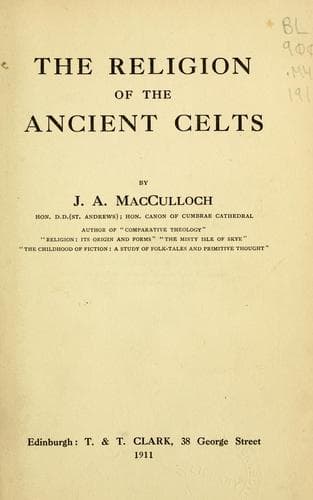
The Religion of the Ancient CeltsMacCulloch, J. A. (John Arnott)
Religion
The Religion of the Ancient Celts
MacCulloch, J. A. (John Arnott)
Celts -- Religion; Mythology, Celtic
With the growth of religion the vaguer spirits tended to become gods and
goddesses, and worshipful animals to become anthropomorphic divinities,
with the animals as their symbols, attendants, or victims. And as the
cult of vegetation spirits centred in the ritual of planting and sowing,
so the cult of the divinities of growth centred in great seasonal and
agricultural festivals, in which the key to the growth of Celtic
religion is to be found. But the migrating Celts, conquering new lands,
evolved divinities of war; and here the old female influence is still at
work, since many of these are female. In spite of possessing so many
local war-gods, the Celts were not merely men of war. Even the _equites_
engaged in war only when occasion arose, and agriculture as well as
pastoral industry was constantly practised, both in Gaul and Britain,
before the conquest.[4] In Ireland, the belief in the dependence of
fruitfulness upon the king, shows to what extent agriculture flourished
there.[5] Music, poetry, crafts, and trade gave rise to culture
divinities, perhaps evolved from gods of growth, since later myths
attributed to them both the origin of arts and crafts, and the
introduction of domestic animals among men. Possibly some culture gods
had been worshipful animals, now worshipped as gods, who had given these
animals to man. Culture-goddesses still held their place among
culture-gods, and were regarded as their mothers. The prominence of
these divinities shows that the Celts were more than a race of warriors.
The pantheon was thus a large one, but on the whole the divinities of
growth were more generally important. The older nature spirits and
divine animals were never quite forgotten, especially by the folk, who
also preserved the old rituals of vegetation spirits, while the gods of
growth were worshipped at the great festivals. Yet in essence the lower
and the higher cults were one and the same, and, save where Roman
influence destroyed Celtic religion, the older primitive strands are
everywhere apparent. The temperament of the Celt kept him close to
nature, and he never quite dropped the primitive elements of his
religion. Moreover, the early influence of female cults of female
spirits and goddesses remained to the end as another predominant factor.
Public-domain text, read in full here on John Shaqi.
Reviews
Reviews
No reviews yet
Be the first to share your thoughts on this work.
Join the Discussion
Join the discussion
Sign in to leave a comment or review.
Sign InorCreate an account