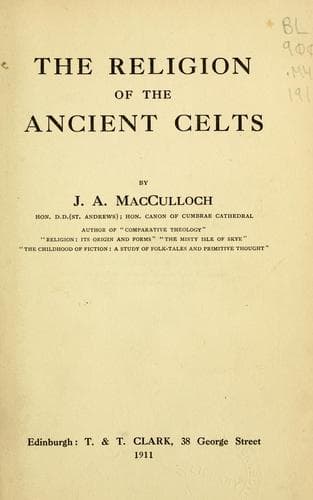
The Religion of the Ancient CeltsMacCulloch, J. A. (John Arnott)
Religion
The Religion of the Ancient Celts
MacCulloch, J. A. (John Arnott)
Celts -- Religion; Mythology, Celtic
Ingenuity and speculation have busied themselves with trying to prove
that the personages of the Arthurian cycle are the old gods of the
Brythons, and the incidents of the romances fragments of the old
mythology. While some of these personages--those already present in
genuinely old Welsh tales and poems or in Geoffrey's _History_--are
reminiscent of the old gods, the romantic presentment of them in the
cycle itself is so largely imaginative, that nothing certain can be
gained from it for the understanding of the old mythology, much less the
old religion. Incidents which are the common stock of real life as well
as of romance are interpreted mythologically, and it is never quite
obvious why the slaying of one hero by another should signify the
conquest of a dark divinity by a solar hero, or why the capture of a
heroine by one knight when she is beloved of another, should make her a
dawn-goddess sharing her favours, now with the sun-god, now with a
"dark" divinity. Or, even granting the truth of this method, what light
does it throw on Celtic religion?
We may postulate a local Arthur saga fusing an old Brythonic god with
the historic sixth century Arthur. From this or from Geoffrey's handling
of it sprang the great romantic cycle. In the ninth century Nennius
Arthur is the historic war-chief, possibly Count of Britain, but in the
reference to his hunting the _Porcus Troit_ (the _Twrch Trwyth_) the
mythic Arthur momentarily appears.[430] Geoffrey's Arthur differs from
the later Arthur of romance, and he may have partially rationalised the
saga, which was either of recent formation or else local and obscure,
since there is no reference to Arthur in the _Mabinogion_--a fact which
shows that "in the legends of Gwynedd and Dyfedd he had no place
whatever,"[431] and also that Arthur the god or mythic hero was also
purely local. In Geoffrey Arthur is the fruit of Igerna's _amour_ with
Uther, to whom Merlin has given her husband's shape. Arthur conquers
many hosts as well as giants, and his court is the resort of all
valorous persons. But he is at last wounded by his wife's seducer, and
carried to the Isle of Avallon to be cured of his wounds, and nothing
more is ever heard of him.[432] Some of these incidents occur also in
the stories of Fionn and Mongan, and those of the mysterious begetting
of a wonder child and his final disappearance into fairyland are local
forms of a tale common to all branches of the Celts.[433] This was
fitted to the history of the local god or hero Arthur, giving rise to
the local saga, to which was afterwards added events from the life of
the historic Arthur. This complex saga must then have acquired a wider
fame long before the romantic cycle took its place, as is suggested by
the purely Welsh tales of _Kulhwych_ and the _Dream of Rhonabwy_, in the
former of which the personages (gods) of the _Mabinogion_ figure in
Arthur's train, though he is far from being the Arthur of the romances.
Public-domain text, read in full here on John Shaqi.
Reviews
Reviews
No reviews yet
Be the first to share your thoughts on this work.
Elsewhere in the archive
Join the Discussion
Join the discussion
Sign in to leave a comment or review.
Sign InorCreate an account