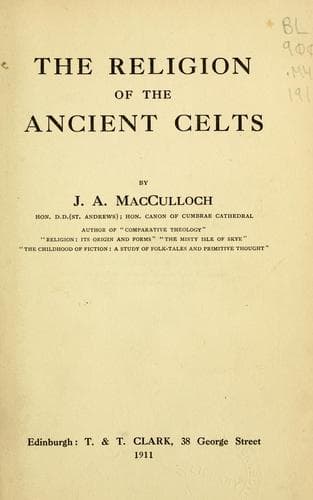
The Religion of the Ancient CeltsMacCulloch, J. A. (John Arnott)
Religion
The Religion of the Ancient Celts
MacCulloch, J. A. (John Arnott)
Celts -- Religion; Mythology, Celtic
Sporadic references to Arthur occur also in Welsh literature, and to the
earlier saga belongs the Arthur who spoils Elysium of its cauldron in a
_Taliesin_ poem.[434] In the _Triads_ there is a mingling of the
historic, the saga, and the later romance Arthur, but probably as a
result of the growing popularity of the saga Arthur he is added to many
Triads as a more remarkable person than the three whom they
describe.[435] Arthurian place-names over the Brythonic area are more
probably the result of the popularity of the saga than that of the later
romantic cycle, a parallel instance being found in the extent of
Ossianic place-names over the Goidelic area as a result of the spread of
the Fionn saga.
The character of the romance Arthur--the flower of knighthood and a
great warrior--and the blending of the historic war-leader Arthur with
the mythic Arthur, suggest that the latter was the ideal hero of certain
Brythonic groups, as Fionn and Cúchulainn of certain Goidelic groups. He
may have been the object of a cult as these heroes perhaps were, or he
may have been a god more and more idealised as a hero. If the earlier
form of his name was Artor, "a ploughman," but perhaps with a wider
significance, and having an equivalent in Artaius, a Gaulish god equated
with Mercury,[436] he may have been a god of agriculture who became a
war-god. But he was also regarded as a culture-hero, stealing a cauldron
and also swine from the gods' land, the last incident euhemerised into
the tale of an unsuccessful theft from March, son of Meirchion,[437]
while, like other culture-heroes, he is a bard. To his story was easily
fitted that of the wonder-child, who, having finally disappeared into
Elysium (later located at Glastonbury), would reappear one day, like
Fionn, as the Saviour of his people. The local Arthur finally attained a
fame far exceeding that of any Brythonic god or hero.
Public-domain text, read in full here on John Shaqi.
Reviews
Reviews
No reviews yet
Be the first to share your thoughts on this work.
Elsewhere in the archive
Join the Discussion
Join the discussion
Sign in to leave a comment or review.
Sign InorCreate an account