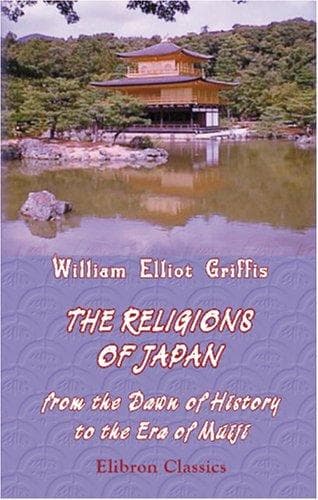
The Religions of Japan, from the Dawn of History to the Era of MéijiGriffis, William Elliot
Religion
The Religions of Japan, from the Dawn of History to the Era of Méiji
Griffis, William Elliot
Japan -- Religion
[Footnote 22: "There remains something of the Shintō heart after
twelve hundred years of foreign creeds and dress. The worship of the
marvellous continues.... Exaggerated force is most impressive.... So the
ancient gods, heroes, and wonders are worshipped still. The simple
countryfolk clap their hands, bow their heads, mumble their prayers, and
offer the fraction of a cent to the first European-built house they
see."--Philosophy in Japan, Past and Present, by Dr. George Wm. Knox.]
[Footnote 23: M.E., p. 474. Honda the Samurai, pp. 256-267.]
[Footnote 24: Kojiki, pp. 127, 136, 213, 217.]
[Footnote 25: See S. and H., pp. 39, 76.
"The appearance of anything unusual at a particular spot is hold to be a
sure sign of the presence of divinity. Near the spot where I live in
Ko-ishi-kawa, Tōkiō, is a small Miya, built at the foot of a very
old tree, that stands isolated on the edge of a rice-field. The spot
looks somewhat insignificant, but upon inquiring why a shrine has been
placed there, I was told that a white snake had been found at the foot
of the old tree." ...
"As it is, the religion of the Japanese consists in the belief that the
productive ethereal spirit, being expanded through the whole universe,
every part is in some degree impregnated with it; and therefore, every
part is in some measure the seat of the Deity."--Legendre's Progressive
Japan, p. 258.]
[Footnote 26: De Verflauwing der Grenzen, by Dr. Abraham Kuyper,
Amsterdam, 1892; translated by Rev. T. Hendrik de Vries, in the
Methodist Review, New York, July-Sept., 1893.]
CHAPTER II
SHINTŌ; MYTHS AND RITUAL
[Footnote 1: The scholar who has made profound researches in all
departments of Japanese learning, but especially in the literature of
Shintō, is Mr. Ernest Satow, now the British Minister at Tangier. He
received the degree of B.A. from the London University. After several
years' study and experience in China, Mr. Satow came to Japan in 1861 as
student-interpreter to the British Legation, receiving his first drill
under Rev. S.R. Brown, D.D., author of A Grammar of Colloquial Japanese.
To ceaseless industry, this scholar, to whom the world is so much
indebted for knowledge of Japan, has added philosophic insight. Besides
unearthing documents whose existence was unsuspected, he has cleared the
way for investigators and comparative students by practically removing
the barriers reared by archaic speech and writing. His papers in the
T.A.S.J., on The Shintō Shrines at Isé, the Revival of Pure
Shintō, and Ancient Japanese Rituals, together with his Hand-book for
Japan, form the best collection of materials for the study of the
original and later forms of Shintō.]
Public-domain text, read in full here on John Shaqi.
Reviews
Reviews
No reviews yet
Be the first to share your thoughts on this work.
Elsewhere in the archive
Join the Discussion
Join the discussion
Sign in to leave a comment or review.
Sign InorCreate an account