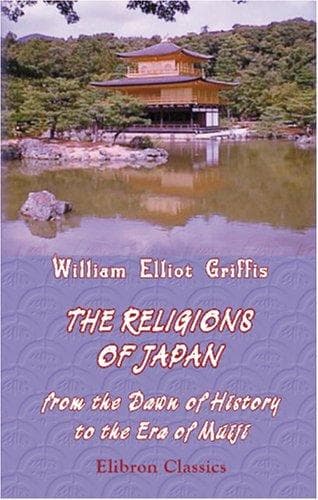
The Religions of Japan, from the Dawn of History to the Era of Méiji — John Shaqi
The Religions of Japan, from the Dawn of History to the Era of MéijiGriffis, William Elliot
Religion
The Religions of Japan, from the Dawn of History to the Era of Méiji
Griffis, William Elliot
Japan -- Religion
The first praises, however, are to be awarded to the English scholars,
Messrs. Satow, Aston, Chamberlain, and others, whose profound researches
in Japanese history, language and literature have cleared the path for
others to tread in. I have tried to acknowledge my debt to them in both
text and appendix.
To several American missionaries, who despite their trying labors have
had the time and the taste to study critically the religions of Japan, I
owe thanks and appreciation. With rare acuteness and learning, Rev. Dr.
George Wm. Knox has opened on its philosophical, and Rev. Dr. J.H.
DeForest on its practical side, the subject of Japanese Confucianism. By
his lexicographical work, Dr. J.C. Hepburn has made debtors to him both
the native and the alien. To our knowledge of Buddhism in Japan, Dr.
J.C. Berry and Rev. J.L. Atkinson have made noteworthy contributions. I
have been content to quote as authorities and illustrations, the names
of those who have thus wrought on the soil, rather than of those, who,
even though world-famous, have been but slightly familiar with the
ethnic and the imported faith of Japan. The profound misunderstandings
of Buddhism, which some very eminent men of Europe have shown in their
writings, form one of the literary curiosities of the world.
In setting forth these Morse lectures, I have purposely robbed my pages
of all appearance of erudition, by using as few uncouth words as
possible, by breaking up the matter into paragraphs of moderate length,
by liberally introducing subject-headings in italics, and by relegating
all notes to the appendix. Since writing the lectures, and even while
reading the final proofs, I have ransacked my library to find as many
references, notes, illustrations and authorities as possible, for the
benefit of the general student. I have purposely avoided recondite and
inaccessible books and have named those easily obtainable from American
or European publishers, or from Messrs. Kelly & Walsh, of Yokohama,
Japan. In using oriental words I have followed, in the main, the
spelling of the Century Dictionary. The Japanese names are expressed
according to that uniform system of transliteration used by Hepburn,
Satow and other standard writers, wherein consonants have the same
general value as in English (except that initial g is always hard),
while the vowels are pronounced as in Italian. Double vowels must be
pronounced double, as in Méiji (mā-ē-jē); those which are long
are marked, as in ō or ū; i before o or u is short. Most of the
important Japanese, as well as Sanskrit and Chinese, terms used, are
duly expressed and defined in the Century Dictionary.
I wish also to thank especially my friends, Riu Watanabe, Ph.D., of
Cornell University, and William Nelson Noble, Esq., of Ithaca. The
former kindly assisted me with criticisms and suggestions, while to the
latter, who has taken time to read all the proofs, I am grateful for
considerable improvement in the English form of the sentences.
Public-domain text, read in full here on John Shaqi.
Reviews
Reviews
No reviews yet
Be the first to share your thoughts on this work.
Join the Discussion
Join the discussion
Sign in to leave a comment or review.
Sign InorCreate an account