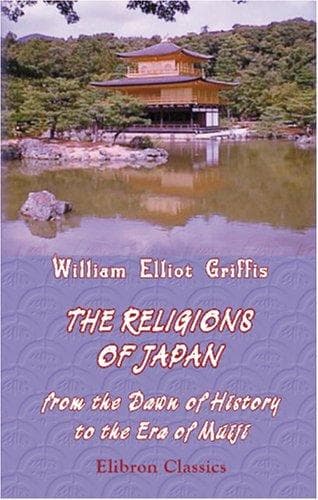
The Religions of Japan, from the Dawn of History to the Era of MéijiGriffis, William Elliot
Religion
The Religions of Japan, from the Dawn of History to the Era of Méiji
Griffis, William Elliot
Japan -- Religion
"Shintō is not our national religion. A faith existed before
it, which was its source. It grew out of superstitious teaching
and mistaken tradition. The history of the rise of Shintō
proves this."--T. Matsugami.
"Makoto wo moté KAMI NO MICHI wo oshiyuréba nari." (Thou
teachest the way of God in truth.)--Mark xii. 14.
"Ware wa Micni nuri, Mukoto nari, Inochi nari."--John
xiv. 6.--The New Testament in Japanese.
CHAPTER III - "THE KOJIKI" AND ITS TEACHINGS
"The Kojiki" mid its Myths of Cosmogony.
As to the origin of the "Kojiki," we have in the closing sentences of
the author's preface the sole documentary authority explaining its scope
and certifying to its authenticity. Briefly the statement is this: The
"Heavenly Sovereign" or Mikado, Temmu (A.D. 673-686), lamenting that the
records possessed by the chief families were "mostly amplified by empty
falsehoods," and fearing that "the grand foundation of the monarchy"
would be destroyed, resolved to preserve the truth. He therefore had the
records carefully examined, compared, and their errors eliminated. There
happened to be in his household a man of marvellous memory, named Hiyéda
Aré, who could repeat, without mistake, the contents of any document he
had ever seen, and never forgot anything which he had heard. This person
was duly instructed in the genuine traditions and old language of former
ages, and made to repeat them until he had the whole by heart. "Before
the undertaking was completed," which probably means before it could be
committed to writing, "the emperor died, and for twenty-five years Aré's
memory was the sole depository of what afterwards received the title of
'Kojiki.' ... At the end of this interval the Empress Gemmiō ordered
Yasumarō to write it down from the mouth of Aré, which accounts for
the completion of the manuscript in so short a time as four months and a
half,"[1] in A.D. 712.
It is from the "Kojiki" that we obtain most of our ideas of ancient life
and thought. The "Nihongi," or Chronicles of Japan, expressed very
largely in Chinese phrases and with Chinese technical and philosophical
terms, further assists us to get a measurably correct idea of what is
called The Divine Age. Of the two books, however, the "Kojiki" is much
more valuable as a true record, because, though rude in style and
exceedingly naïve in expression, and by no means free from Chinese
thoughts and phrases, it is marked by a genuinely Japanese cast of
thought and method of composition. Instead of the terse, carefully
measured, balanced, and antithetical sentences of correct Chinese, those
of the "Kojiki" are long and involved, and without much logical
connection. The "Kojiki" contains the real notions, feelings, and
beliefs of Japanese who lived before the eighth century.
Public-domain text, read in full here on John Shaqi.
Reviews
Reviews
No reviews yet
Be the first to share your thoughts on this work.
Join the Discussion
Join the discussion
Sign in to leave a comment or review.
Sign InorCreate an account