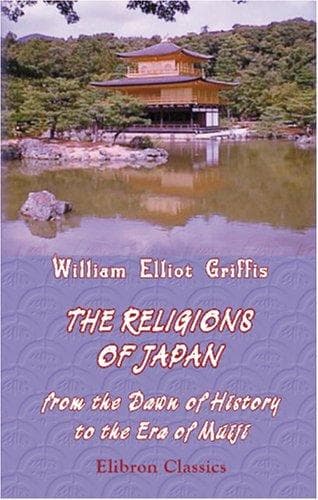
The Religions of Japan, from the Dawn of History to the Era of MéijiGriffis, William Elliot
Religion
The Religions of Japan, from the Dawn of History to the Era of Méiji
Griffis, William Elliot
Japan -- Religion
Besides the twenty-seven Norito which are found in the Yengishiki,
published at the opening of the tenth century, there are many others
composed for single occasions. Examples of these are found in the
Government Gazettes. One celebrates the Mikado's removal from Kiōto
to Tōkiō, another was written and recited to add greater solemnity
to the oath which he took to govern according to modern liberal
principles and to form a national parliament. To those Japanese whose
first idea of duty is loyalty to the emperor, Shintō thus becomes a
system of patriotism exalted to the rank of a religion. Even Christian
natives of Japan can use much of the phraseology of the Norito while
addressing their petitions on behalf of their chief magistrate to the
King of kings.
The primitive worship of the sun, of light, of fire, has left its
impress upon the language and in vernacular art and customs. Among
scores of derivations of Japanese words (often more pleasing than
scientific), in which the general term _hi_ enters, is that which finds
in the word for man, _hito_, the meaning of "light-bearer." On the face
of the broad terminal tiles of the house-roofs, we still see moulded the
river-weed, with which the Clay-Hill Maiden pacified the Fire-God. On
the frontlet of the warrior's helmet, in the old days of arrow and
armor, glittered in brass on either side of his crest the same symbol of
power and victory.
Having glanced at the ritual of Shintō, let us now examine the
teachings of its oldest book.
CHAPTER III - "THE KOJIKI" AND ITS TEACHINGS
"Japan is not a land where men need pray,
For 'tis itself divine:
Yet do I lift my voice in prayer..."
Hitomaro, + A.D. 737.
"Now when chaos had begun to condense, but force and form were
not yet manifest, and there was naught named, naught done, who
could know its shape? Nevertheless Heaven and Earth first
parted, and the three Deities performed the commencement of
creation; the Passive and Active Essences then developed, and
the Two Spirits became the ancestors of all things."--Preface of
Yasumarō (A.D. 712) to the "Kojiki."
"These, the 'Kojiki' and 'Nihongi' are their [the Shintōists]
canonical books, ... and almost their every word is considered
undeniable truth."
"The Shintō faith teaches that God inspired the foundation of
the Mikadoate, and that it is therefore sacred."--Kaburagi.
"We now reverently make our prayer to Them [Our Imperial
Ancestors] and to our Illustrious Father [Komei, + 1867], and
implore the help of Their Sacred Spirits, and make to Them
solemn oath never at this time nor in the future to fail to be
an example to Our subjects in the observance of the Law
[Constitution] hereby established."--Imperial oath of the
Emperor Mutsuhito in the sanctuary in the Imperial Palace,
Tōkiō, February 11, 1889.
Public-domain text, read in full here on John Shaqi.
Reviews
Reviews
No reviews yet
Be the first to share your thoughts on this work.
Join the Discussion
Join the discussion
Sign in to leave a comment or review.
Sign InorCreate an account