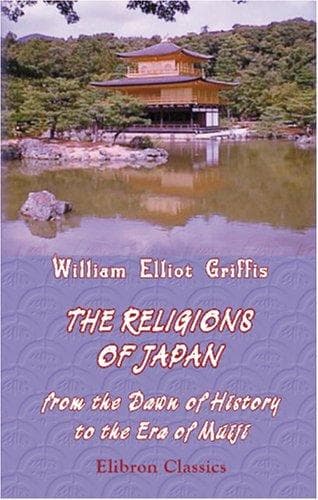
The Religions of Japan, from the Dawn of History to the Era of Méiji — John Shaqi
The Religions of Japan, from the Dawn of History to the Era of MéijiGriffis, William Elliot
Religion
The Religions of Japan, from the Dawn of History to the Era of Méiji
Griffis, William Elliot
Japan -- Religion
Strange as it may seem, before Buddhism captured and made use of
Shintō for its own purposes (just as it stands ready to-day to absorb
Christianity by making Jesus one of the Palestinian avatars of the
Buddha), the house or tribe of Yamato, with its claim to descent from
the heavenly gods, and with its Mikado or god-ruler, had given to the
Buddhists a precedent and potent example. Shintō, as a state religion
or union of politics and piety, with its system of shrines and
festivals, and in short the whole Kami no Michi, or Shintō as we know
it, from the sixth to the eighth century, was in itself (in part at
least), a case of the absorption of one religion by another.
In short, the Mikado tribe or Yamato clan did, in reality, capture the
aboriginal religion, and turn it into a great political machine. They
attempted syncretism and succeeded in their scheme. They added to their
own stock of dogma and fetich that of the natives. Only, while
recognizing the (earth) gods of the aborigines they proclaimed the
superiority of the Mikado as representative and vicegerent of Heaven,
and demanded that even the gods of the earth, mountain, river, wind, and
thunder and lightning should obey him. Not content, however, with
absorbing and corrupting for political purposes the primitive faith of
the aborigines, the invaders corrupted their own religion by carrying
the dogma of the divinity and infallibility of the Mikado too far.
Stopping short of no absurdity, they declared their chief greater even
than the heavenly gods, and made their religion centre in him rather
than in his alleged heavenly ancestors, or "heaven." In the interest of
politics and conquest, and for the sake of maintaining the prestige of
their tribe and clan, these "Mikado-reverencers" of early ages advanced
from dogma to dogma, until their leader was virtually chief god in a
great pantheon.
A critical native Japanese, student of the Kojiki and of the early
writings, Professor Kumi, formerly of the Imperial University in
Tōkiō, has brought to light abundant evidence to show that the
aboriginal religion found by the Yamato conquerors was markedly
different at many vital points, from that which was long afterward
called Shintō.
Public-domain text, read in full here on John Shaqi.
Reviews
Reviews
No reviews yet
Be the first to share your thoughts on this work.
Join the Discussion
Join the discussion
Sign in to leave a comment or review.
Sign InorCreate an account