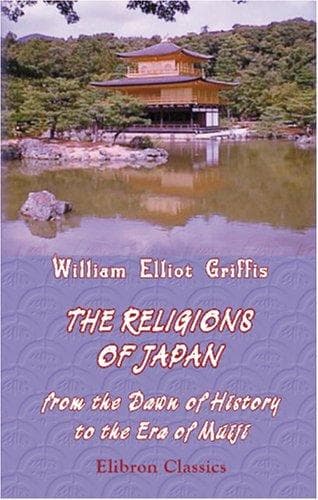
The Religions of Japan, from the Dawn of History to the Era of Méiji — John Shaqi
The Religions of Japan, from the Dawn of History to the Era of MéijiGriffis, William Elliot
Religion
The Religions of Japan, from the Dawn of History to the Era of Méiji
Griffis, William Elliot
Japan -- Religion
If the view of recent students of anthropology be correct, that the
elements dominating the population in ancient Japan were in the south,
Malay; in the north, Aino; and in the central region, or that occupied
by the Yamato men, Korean; then, these continental invaders may have
been worshippers of Heaven and have possessed a religion closely akin to
that of ancient China with its monotheism. It is very probable also that
they came into contact with tribes or colonies of their
fellow-continentals from Asia. These tribes, hunters, fishermen, or rude
agriculturists--who had previously reached Japan--practised many rites
and ceremonies which were much like those of the new invaders. It is
certain also, as we have seen, that the Yamato men made ultimate
conquest and unification of all the islanders, not merely by the
superiority of their valor and of their weapons of iron, but also by
their dogmas. After success in battle, and the first beginnings of rude
government, they taught their conquered subjects or over-awed vassals,
that they were the descendants of the heavenly gods; that their
ancestors had come down from heaven; find that their chief or Mikado was
a god. According to the same dogmatics, the aborigines were descendants
of the earth-born gods, and as such must obey the descendants of the
heavenly gods, and their vicegerent upon the earth, the Mikado.
Purification of Offences.
These heaven-descended Yamato people were in the main agriculturists,
though of a rude order, while the outlying tribes were mostly hunters
and fishermen; and many of the rituals show the class of crimes which
nomads, or men of unsettled life, would naturally commit against their
neighbors living in comparatively settled order. It is to be noted that
in the god-way the origin of evil is to be ascribed to evil gods. These
kami pollute, and pollution is iniquity. From this iniquity the people
are to be purged by the gods of purification, to whom offerings are duly
made.
He who would understand the passion for cleanliness which characterizes
the Japanese must look for its source in their ancient religion. The
root idea of the word _tsumi_, which Mr. Satow translated as "offence,"
is that of pollution. On this basis, of things pure and things defiling,
the ancient teachers of Shintō made their classification of what was
good and what was bad. From the impression of what was repulsive arose
the idea of guilt.
In rituals translated by Mr. Satow, the list of offences is given and
the defilements are to be removed to the nether world, or, in common
fact, the polluted objects and the expiatory sacrifices are to be thrown
into the rivers and thence carried to the sea, where they fall to the
bottom of the earth. The following norito clearly shows this.
Furthermore, as Mr. Satow, the translator, points out, this ritual
contains the germ of criminal law, a whole code of which might have been
evolved and formulated under Shintō, had not Buddhism arrested its
growth.
Public-domain text, read in full here on John Shaqi.
Reviews
Reviews
No reviews yet
Be the first to share your thoughts on this work.
Join the Discussion
Join the discussion
Sign in to leave a comment or review.
Sign InorCreate an account