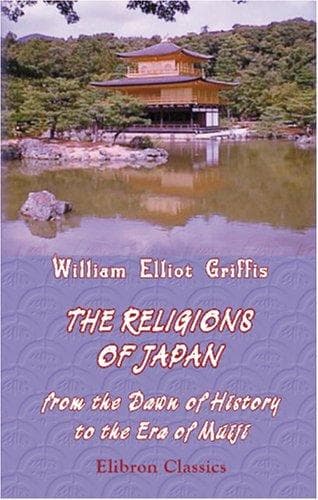
The Religions of Japan, from the Dawn of History to the Era of MéijiGriffis, William Elliot
Religion
The Religions of Japan, from the Dawn of History to the Era of Méiji
Griffis, William Elliot
Japan -- Religion
And when she has thus gulped them down, the lord of the
Breath-blowing-place, who dwells in the Breath-blowing-place,
shall utterly blow them away with his breath to the
Root-country, the Bottom-country.
And when he has thus blown them away, the deity called the
Maiden-of-Swift-Banishment, who dwells in the Root-country, the
Bottom-country, shall completely banish them, and get rid of
them.
And when they have thus been got rid of, there shall from this
day onwards be no offence which is called offence, with regard
to the men of the offices who serve in the court of the Sovran,
nor in the four quarters of the region under heaven.
Then the high priest says:
Hear all of you how he leads forth the horse, as a thing that
erects its ears towards the plain of high heaven, and deigns to
sweep away and purify with the general purification, as the
evening sun goes down on the last day of the watery moon of this
year.
O diviners of the four countries, take (the sacrifices) away out
to the river highway, and sweep them away.
Mikadoism Usurps the Primitive God-way.
A further proof of the transformation of the primitive god-way in the
interest of practical politics, is shown by Professor Kumi in the fact
that some of the festivals now directly connected with the Mikado's
house, and even in his honor, were originally festivals with which he
had nothing to do, except as leader of the worship, for the honor was
paid to Heaven, and not to his ancestors. Professor Kumi maintains that
the thanksgivings of the court were originally to Heaven itself, and not
in honor of Amatérasŭ, the sun-goddess, as is now popularly believed.
It is related in the Kojiki that Amatérasŭ herself celebrated the
feast of Niinamé. So also, the temple of Isé, the Mecca of Shintō,
and the Holy shrine in the imperial palace were originally temples for
the worship of Heaven. The inferior gods of earthly origin form no part
of primitive Shintō.
Not one of the first Mikados was deified after death, the deification of
emperors dating from the corruption which Shintō underwent after the
introduction of Buddhism. Only by degrees was the ruler of the country
given a place in the worship, and this connection was made by
attributing to him descent from Heaven. In a word, the contention of
Professor Kumi is, that the ancient religion of at least a portion of
the Japanese and especially of those in central Japan, was a rude sort
of monotheism, coupled, as in ancient China, with the worship of
subordinate spirits.
Public-domain text, read in full here on John Shaqi.
Reviews
Reviews
No reviews yet
Be the first to share your thoughts on this work.
Join the Discussion
Join the discussion
Sign in to leave a comment or review.
Sign InorCreate an account