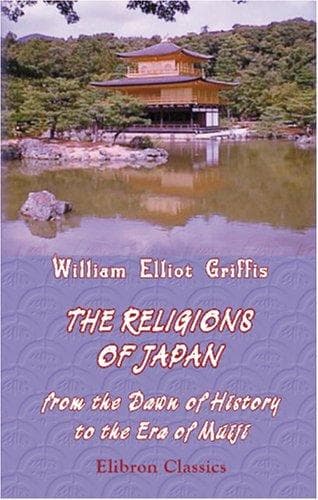
The Religions of Japan, from the Dawn of History to the Era of MéijiGriffis, William Elliot
Religion
The Religions of Japan, from the Dawn of History to the Era of Méiji
Griffis, William Elliot
Japan -- Religion
It is needless to say that such applications of the higher criticism to
the ancient sacred documents proved to be no safer for the applier than
if he had lived in the United States of America. The orthodox
Shintōists were roused to wrath and charged the learned critic with
"degrading Shintō to a mere branch of Christianity." The government,
which, despite its Constitution and Diet, is in the eyes of the people
really based on the myths of the Kojiki, quickly put the professor on
the retired list.[25]
It is probably correct to say that the arguments adduced by Professor
Kumi, confirm our theory of the substitution in the simple god-way, of
Mikadoism, the centre of the primitive worship being the sun and nature
rather than Heaven.
Between the ancient Chinese religion with its abstract idea of Heaven
and its personal term for God, and the more poetic and childlike system
of the god-way, there seems to be as much difference as there is
racially between the people of the Middle Kingdom and those of the Land
Where the Day Begins. Indeed, the entrance of Chinese philosophical and
abstract ideas seemed to paralyze the Japanese imagination. Not only did
myth-making, on its purely æsthetic and non-utilitarian side cease
almost at once, but such myths as were formed were for direct business
purposes and with a transparent tendency. Henceforth, in the domain of
imagination the Japanese intellect busied itself with assimilating or
re-working the abundant material imported by Buddhism.
Ancient Customs and Usages.
In the ancient god-way the temple or shrine was called a miya. After the
advent of Buddhism the keepers of the shrine were called kannushi, that
is, shrine keepers or wardens of the god. These men were usually
descendants of the god in whose honor the temples were built. The gods
being nothing more than human founders of families, reverence was paid
to them as ancestors, and so the basis of Shintō is ancestor worship.
The model of the miya, in modern as in ancient times, is the primitive
hut as it was before Buddhism introduced Indian and Chinese
architecture. The posts, stuck in the ground, and not laid upon stones
as in after times, supported the walls and roof, the latter being of
thatch. The rafters, crossed at the top, were tied along the ridge-pole
with the fibres of creepers or wistaria vines. No paint, lacquer,
gilding, or ornaments of any sort existed in the ancient shrine, and
even to-day the modern Shintō temple must be of pure hinoki or
sun-wood, and thatched, while the use of metal is as far as possible
avoided. To the gods, as the norito show, offerings of various kinds
were made, consisting of the fruits of the soil, the products of the
sea, and the fabrics of the loom.
Public-domain text, read in full here on John Shaqi.
Reviews
Reviews
No reviews yet
Be the first to share your thoughts on this work.
Join the Discussion
Join the discussion
Sign in to leave a comment or review.
Sign InorCreate an account