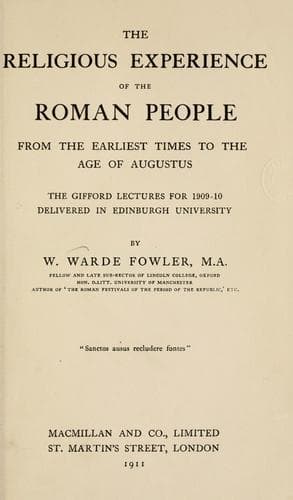
The Religious Experience of the Roman People: From the Earliest Times to the Age of AugustusFowler, W. Warde (William Warde)
Religion
The Religious Experience of the Roman People: From the Earliest Times to the Age of Augustus
Fowler, W. Warde (William Warde)
Cults -- Rome; Rome -- Religion
primitive system which existed in Latium, probably at Alba, where
Jupiter was worshipped on the mountain from time immemorial. When the
strength of Latium was concentrated at the best strategical point on the
Tiber, the priest of Jupiter was transferred to the new city, because he
was too "precious" to be left behind, though even then a relic of
antiquity. There he became what he was throughout Roman history, a
practically useless personage, about whom certain sacred traditions had
gathered, but placed in complete subjection to the new legal and
religious king, and afterwards to the Pontifex maximus.[218]
If there be any truth in this--and I believe it to be a legitimate
inference from the legal position of this Flamen, and his permanent
state of taboo--then I think we may see a great religious change in the
era of the "calendar of Numa." Inspired with new ideas of the duty and
destiny of the new city of the four regions, a priest-king, doubtless
with the help and advice of a council, according to the true Roman
fashion, put an end for ever to the reign of the old magician-kingship,
but preserved the magician-king as a being still capable of
wonder-working in the eyes of the people. As religious law displaced
magic in the State ritual, so the new kings, with their collegia of
legal priests, pontifices and augurs, neutralised and gradually
destroyed the prestige of the effete survivor of an age of barbarism.
NOTES TO LECTURE V.
[185] Kornemann, _op. cit._ p. 87; Wissowa, _Gesammelte
Abhandlungen_, p. 230 foll.; Mommsen, _Staatsrecht_,
iii. p. 790, note 1. For the festival of the
Septimontium, Varro, _L.L._ vi. 24; Plutarch, _Quaest.
Rom._ 69; Fowler, _R.F._ p. 265 foll. This festival does
not appear in the calendar, as not being "feriae populi,
sed montanorum modo" (Varro, _l.c._). There are some
interesting remarks on the relation between agricultural
life and the origin of towns in von Jhering's _Evolution
of the Aryan_ (Eng. trans.), p. 86 foll., with special
reference to Rome.
[186] Von Duhn in _J.H.S._ xvi. 126 foll. The latest
research (Korte in Pauly-Wissowa, _s.v._ "Etrusker," p.
747) concludes that the arrival of the Etruscans on the
west coast of Italy cannot be safely put earlier than
the eighth century.
[187] Huelsen-Jordan, _Rom. Topogr._ iii. 153. In a brief
but masterly paper in the publications of the _American
School at Rome_, 1908, p. 173 foll., J. B. Carter deals
with the whole problem of the pomoerium and the
pre-Servian city.
[188] Wissowa, _R.K._ p. 27.
[189] In _C.I.L._ i.^2, p. 297 foll. See _R.F._ p. 14
foll.
[190] See the Fasti in _R.F._ p. 21 foll.; or in
Wissowa, _R.K._, at end of the book.
Public-domain text, read in full here on John Shaqi.
Reviews
Reviews
No reviews yet
Be the first to share your thoughts on this work.
Elsewhere in the archive
Join the Discussion
Join the discussion
Sign in to leave a comment or review.
Sign InorCreate an account