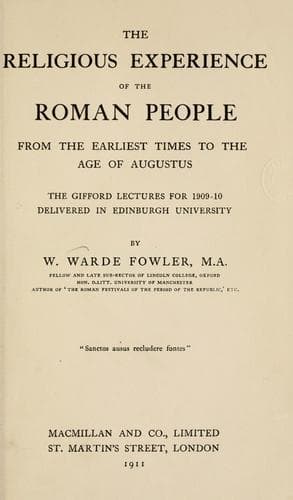
The Religious Experience of the Roman People: From the Earliest Times to the Age of Augustus — John Shaqi
The Religious Experience of the Roman People: From the Earliest Times to the Age of AugustusFowler, W. Warde (William Warde)
Religion
The Religious Experience of the Roman People: From the Earliest Times to the Age of Augustus
Fowler, W. Warde (William Warde)
Cults -- Rome; Rome -- Religion
We have thus to face two formidable facts: (1) that the period covered
by my earlier lectures must in honesty be called prehistoric; and (2)
that when the Romans themselves began to write about it they did so
under the overwhelming influence of Greek culture. With few exceptions,
all that we can learn of the early Roman religion from Roman or Greek
writers comes to us, not in a pure Roman form, clearly conceived as all
things truly Roman were, but seen dimly through the mist of the
Hellenistic age. The Roman gods, for example, are made the sport of
fancy and the subject of Hellenistic love-stories, by Greek poets and
their Roman imitators,[13] or are more seriously treated by Graeco-Roman
philosophy after a fashion which would have been absolutely
incomprehensible to the primitive men in whose minds they first had
their being. The process of disentangling the Roman element from the
Greek in the literary evidence is one which can never be satisfactorily
accomplished; and on the whole it is better, with Wissowa and Marquardt,
to hold fast by the facts of the cult, where the distinction between the
two is usually obvious, than to flounder about in a slough of what I can
only call pseudo-evidence. If all that English people knew about their
Anglo-Saxon forefathers were derived from Norman-French chroniclers, how
much should we really know about government or religion in the centuries
before the Conquest! And yet this comparison gives but a faint idea of
the treacherous nature of the literary evidence I am speaking of. It is
true indeed that in the last age of the Republic a few Romans began to
take something like a scientific interest in their own religious
antiquities; and to Varro, by far the most learned of these, and to
Verrius Flaccus, who succeeded him in the Augustan age, we owe directly
or indirectly almost all the solid facts on which our knowledge of the
Roman worship rests. But their works have come down to us in a most
imperfect and fragmentary state, and what we have of them we owe mainly
to the erudition of later grammarians and commentators, and the learning
of the early Christian fathers, who drew upon them freely for
illustrations of the absurdities of paganism. And it must be added that
when Varro himself deals with the Roman gods and the old ideas about
them, he is by no means free from the inevitable influence of Greek
thought.
Public-domain text, read in full here on John Shaqi.
Reviews
Reviews
No reviews yet
Be the first to share your thoughts on this work.
Join the Discussion
Join the discussion
Sign in to leave a comment or review.
Sign InorCreate an account