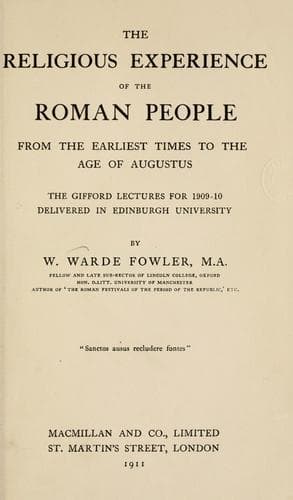
The Religious Experience of the Roman People: From the Earliest Times to the Age of AugustusFowler, W. Warde (William Warde)
Religion
The Religious Experience of the Roman People: From the Earliest Times to the Age of Augustus
Fowler, W. Warde (William Warde)
Cults -- Rome; Rome -- Religion
Apart from the literary material and the few surviving fragments of
religious law and ritual, there are two other sources of light of which
we can now avail ourselves, archaeology and anthropology; but it must be
confessed that as yet their illuminating power is somewhat uncertain. It
reminds the scrupulous investigator of those early days of the electric
light, when its flickering tremulousness made it often painful to read
by, and when, too, it might suddenly go out and leave the reader in
darkness. It is well to remember that both sciences are young, and have
much of the self-confidence of youth; and that Italian archaeology, now
fast becoming well organised within Italy, has also to be co-ordinated
with the archaeology of the whole Mediterranean basin, before we can
expect from it clear and unmistakable answers to hard questions about
race and religion. This work, which cannot possibly be done by an
individual without _co-operation_--the secret of sound work which the
Germans have long ago discovered--is in course of being carried out, so
far as is at present possible, by a syndicate of competent
investigators.[14]
In order to indicate the uncertain nature of the light which for a long
time to come is all we can expect from Italian archaeology, I have only
to remind you that one of the chief questions we have to ask of it is
the relation of the mysterious Etruscan people to the other Italian
stocks, in respect of language, religion, and art. Whether the Etruscans
were the same people whom the Greeks called Pelasgians, as many
investigators now hold: whether the earliest Roman city was in any true
sense an Etruscan one: these are questions on the answers to which it is
not as yet safe to build further hypotheses. In regard to religion, too,
we are still very much in the dark. For example, there are many Etruscan
works of art in which Roman deities are portrayed, as is certain from
the fact that their names accompany the figures; but it is as yet almost
impossible to determine how far we can use these for the interpretation
of Roman religious ideas or legends. Many years ago a most attractive
hypothesis was raised on the evidence of certain of these works of art,
where Hercules and Juno appear together in a manner which strongly
suggests that they are meant to represent the male and female principles
of human life; this hypothesis was taken up by early writers in the
_Mythological Lexicon_, and relying upon them I adopted it in my _Roman
Festivals_,[15] and further applied it to the interpretation of an
unsolved problem in the fourth _Eclogue_ of Virgil.[16] But since then
doubt has been thrown on it by Wissowa, who had formerly accepted it. As
being of Etruscan origin, and found in places very distant from each
other and from Rome, we have, he says, no good right to use these works
of art as evidence for the Roman religion.[17] The question remains open
as to these and many other works of art, but the fact that the man of
Public-domain text, read in full here on John Shaqi.
Reviews
Reviews
No reviews yet
Be the first to share your thoughts on this work.
Join the Discussion
Join the discussion
Sign in to leave a comment or review.
Sign InorCreate an account