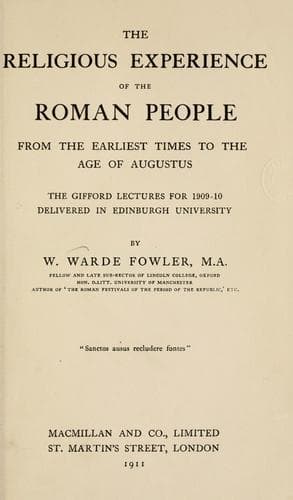
The Religious Experience of the Roman People: From the Earliest Times to the Age of AugustusFowler, W. Warde (William Warde)
Religion
The Religious Experience of the Roman People: From the Earliest Times to the Age of Augustus
Fowler, W. Warde (William Warde)
Cults -- Rome; Rome -- Religion
coolest judgment and most absolute honesty is doubtful, suggests that we
had best wait patiently for more certain light.
In Rome itself, where archaeological study is concentrated and admirably
staffed, great progress has been made, and much light thrown on the
later periods of religious history. But for the religion of the ancient
Roman state, with which we are at present concerned, it must be
confessed that very little has been gleaned. The most famous discovery
is that recently made in the Forum of an archaic inscription which
almost certainly relates to some religious act; but as yet no scholar
has been able to interpret it with anything approaching to
certainty.[18] More recently excavations on the further bank of the
Tiber threw a glint of light on the nature of an ancient deity, Furrina,
about whom till then we practically knew nothing at all; but the
evidence thus obtained was late and in Greek characters. We must in fact
entertain no great hopes of illumination from excavations, but accept
thankfully what little may be vouchsafed to us. On the other hand, from
the gradual development of Italian archaeology as a whole, and, I must
here add, from the study of the several old Italian languages, much may
be expected in the future.
The other chief contributory science is anthropology, _i.e._ the study
of the working of the mind of primitive man, as it is seen in the ideas
and practices of uncivilised peoples at the present day, and also as it
can be traced in survivals among more civilised races. For the history
of the religion of the Roman City-state its contribution must of
necessity be a limited one; that is a part of Roman history in general,
and its material is purely Roman, or perhaps I should say, Graeco-Roman;
and Wissowa in all his work has consistently declined to admit the value
of anthropological researches for the elucidation of Roman problems.
Perhaps it is for this very reason that his book is the safest guide we
possess for the study of what the Romans did and thought in the matter
of religion; but if we wish to try and get to the original significance
of those acts and thoughts, it is absolutely impossible in these days to
dispense with the works of a long series of anthropologists, many of
them fortunately British, who have gradually been collecting and
classifying the material which in the long run will fructify in definite
results. If we consider the writings of eminent scholars who wrote about
Greek and Roman religion and mythology before the appearance of Dr.
Tylor's _Primitive Culture_--Klausen, Preuner, Preller, Kuhn, and many
others, who worked on the comparative method but with slender material
for the use of it--we see at once what an immense advance has been
effected by that monumental work, and by the stimulus that it gave to
others to follow the same track. Now we have in this country the works
of Lang, Robertson Smith, Farnell, Frazer, Hartland, Jevons, and others,
Public-domain text, read in full here on John Shaqi.
Reviews
Reviews
No reviews yet
Be the first to share your thoughts on this work.
Join the Discussion
Join the discussion
Sign in to leave a comment or review.
Sign InorCreate an account