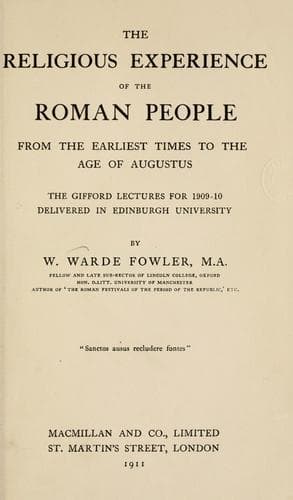
The Religious Experience of the Roman People: From the Earliest Times to the Age of AugustusFowler, W. Warde (William Warde)
Religion
The Religious Experience of the Roman People: From the Earliest Times to the Age of Augustus
Fowler, W. Warde (William Warde)
Cults -- Rome; Rome -- Religion
We may thus be quite certain, that though they had lost their old
monopoly of religious knowledge, the pontifices found plenty of fresh
work to do in this period. It is my belief that they now became more
active than they ever had been. From this time, for example, we may
almost certainly date their literary or quasi-literary activity; I mean
the practice of recording the leading events of each year, which may
have had its origin a century earlier, with the eclipse of the sun in or
about 404 B.C.[573] I should guess that after the admission of the
plebeians to the college in 300 B.C., the new members put fresh life and
vigour into the old work, and developed it in various directions. It is
in this period that I am inclined to attribute to the college that zeal
for compiling and perhaps inventing religious formulae of all kinds,
which took shape in the _libri_ or _commentarii pontificum_, and
embodied that strange manual of the methods of addressing deities, which
we know as _Indigitamenta_. And again, in the skilled work of the
admission of new deities and the dedication of their temples, occasioned
by the new organisation and condition of Italy, and lastly, in the
supervision of the proper methods of expiating _prodigia_, which (though
the habit is doubtless an old one) began henceforward to be reported to
the Senate from all parts of the ager Romanus and even beyond, their
meetings in the Regia must have been fully occupied. Our loss is great
indeed in the total want of detail about the life and character of the
great plebeian pontifex maximus of the first half of the third century
B.C., that Titus Coruncanius whom I have already mentioned as being a
Latin by birth; for Cicero declares that the _commentarii_ of the
college showed him as a man of the greatest ability,[574] whose
reputation remained for ages as one who was ready with wise counsel in
matters both public and private. Coupling him with two other memorable
holders of the office, he says that "et in senatu et apud populum et in
causis amicorum et domi et militiae consilium suum fidemque
praestabant."[575] This passage should be remembered as a valuable
illustration of the way in which the college and its head were becoming
more and more occupied with secular business; it is worth noting, too,
that this great man was himself consul in the year 280, and took a
useful part in the first campaign against Pyrrhus.[576] Yet Cicero makes
it plain that he looked on him also as a great figure in religious
matters--nay, even as a man whom the gods loved.[577]
Public-domain text, read in full here on John Shaqi.
Reviews
Reviews
No reviews yet
Be the first to share your thoughts on this work.
Elsewhere in the archive
Join the Discussion
Join the discussion
Sign in to leave a comment or review.
Sign InorCreate an account