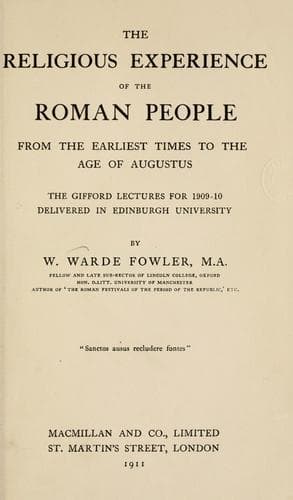
The Religious Experience of the Roman People: From the Earliest Times to the Age of AugustusFowler, W. Warde (William Warde)
Religion
The Religious Experience of the Roman People: From the Earliest Times to the Age of Augustus
Fowler, W. Warde (William Warde)
Cults -- Rome; Rome -- Religion
[556] See Mulder, _De notione conscientiae, quae et
qualis fuerit Romanis_, Leyden, 1908, cap. 2. On p. 56
he quotes Luthard (_Die antike Ethik_, p. 131), who says
of the Roman religion that it was even more an affair of
the State than with any other people; hence its peculiar
legal character. Though Mulder overworks his point, his
chapter (especially p. 61 foll.) is full of interest.
[557] Wissowa, _R.K._ p. 431. The first chapter of
Ambrosch's _Studien und Andeutungen_, in which the
nature and history of the Regia was first really
investigated, is still valuable. An excellent short
account is given by Mr. Marindin in his article in the
_Dict. of Antiquities_, ed. 2. It is now generally
maintained that the Regia in historical times was rather
a building for sacred purposes than a residence for a
man and his family, and this I hold to be correct; but
it may for all that have originally been the residence
of the Rex and of the Pont. Max. when the Rex had
disappeared.
[558] See Schanz, _Gesch. der roem. Literatur_, i. 43,
where a succinct account is given of modern opinion as
to the so-called _ius Papirianum_. The main argument for
the late date of the collection is that Cicero does not
seem to have known of it when he wrote the letter _ad
Fam._ ix. 21 in 46 B.C. This of course in no way affects
the primitive character of the rules themselves.
[559] The inference that the rules were found in the
_Libri pontificum_ is inevitable in any case, but seems
proved by the fact that one of them, that relating to
the _spolia opima_, is stated by Festus, p. 189 (_s.v._
"opima"), to have been extracted from those books.
[560] Festus, _s.v._ "pellices" and _s.v._ "plorare,"
which latter word is interpreted as = _inclamare_.
[561] The _divi parentum_ are here generally taken as
those of the particular family, and this may have been
so; but cf. Wissowa, _R.K._ 192.
[562] For the attempts of Pais in Italy and Lambert in
France to date the Tables at the end of the fourth
century or later, see Schanz, _op. cit._ i. 41. In
Germany opinion is universally in favour of the
traditional date.
[563] See _Social Life at Rome in the Age of Cicero_, p.
135.
[564] On the religious character of _confarreatio_ see
De Marchi, _La Religione nella vita privata_, i. p. 145
foll.
[565] Cic. _de Domo_, 12. 14; Gellius, v. 19.
Public-domain text, read in full here on John Shaqi.
Reviews
Reviews
No reviews yet
Be the first to share your thoughts on this work.
Elsewhere in the archive
Join the Discussion
Join the discussion
Sign in to leave a comment or review.
Sign InorCreate an account