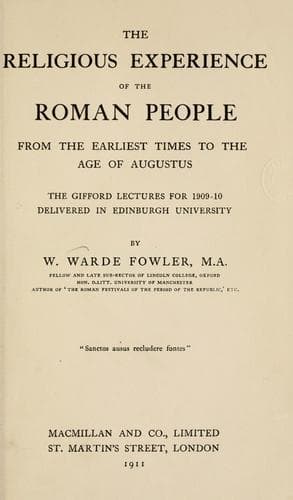
The Religious Experience of the Roman People: From the Earliest Times to the Age of Augustus — John Shaqi
The Religious Experience of the Roman People: From the Earliest Times to the Age of AugustusFowler, W. Warde (William Warde)
Religion
The Religious Experience of the Roman People: From the Earliest Times to the Age of Augustus
Fowler, W. Warde (William Warde)
Cults -- Rome; Rome -- Religion
Survivals at Rome of previous eras of quasi-religious
experience. Totemism not discernible. Taboo, and the
means adopted of escaping from it; both survived at Rome
into an age of real religion. Examples: impurity (or
holiness) of new-born infants; of a corpse; of women in
certain worships; of strangers; of criminals. Almost
complete absence of blood-taboo. Iron. Strange taboos on
the priest of Jupiter and his wife. Holy or tabooed
places; holy or tabooed days; the word _religiosus_ as
applied to both of these 24-46
LECTURE III
ON THE THRESHOLD OF RELIGION: MAGIC
Magic; distinction between magic and religion. Religious
authorities seek to exclude magic, and did so at Rome.
Few survivals of magic in the State religion. The
_aquaelicium_. Vestals and runaway slaves. The magical
whipping at the Lupercalia. The throwing of puppets from
the _pons sublicius_. Magical processes surviving in
religious ritual with their meaning lost. Private magic:
_excantatio_ in the XII. Tables; other spells or
_carmina_. Amulets: the _bulla_; _oscilla_ 47-67
LECTURE IV
THE RELIGION OF THE FAMILY
Continuity of the religion of the Latin agricultural
family. What the family was; its relation to the _gens_.
The _familia_ as settled on the land, an economic unit,
embodied in a _pagus_. The house as the religious centre
of the _familia_; its holy places. Vesta, Penates,
Genius, and the spirit of the doorway. The _Lar
familiaris_ on the land. Festival of the Lar belongs to
the religion of the _pagus_: other festivals of the
_pagus_. _Religio terminorum._ Religion of the
household: marriage, childbirth, burial and cult of the
dead 68-91
LECTURE V
THE CALENDAR OF NUMA
Beginnings of the City-state: the _oppidum_. The
earliest historical Rome, the city of the four regions;
to this belongs the surviving religious calendar. This
calendar described; the basis of our knowledge of early
Roman religion. It expresses a life agricultural,
political, and military. Days of gods distinguished from
days of man. Agricultural life the real basis of the
calendar; gradual effacement of it. Results of a fixed
routine in calendar; discipline, religious confidence.
Exclusion from it of the barbarous and grotesque.
Decency and order under an organising priestly authority
92-113
LECTURE VI
THE DIVINE OBJECTS OF WORSHIP
Public-domain text, read in full here on John Shaqi.
Reviews
Reviews
No reviews yet
Be the first to share your thoughts on this work.
Join the Discussion
Join the discussion
Sign in to leave a comment or review.
Sign InorCreate an account