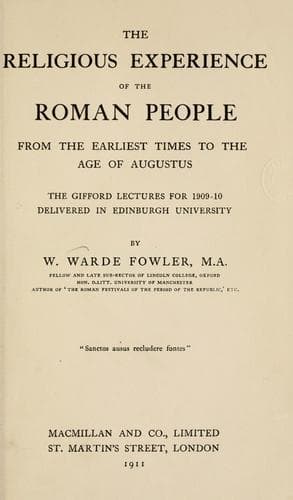
The Religious Experience of the Roman People: From the Earliest Times to the Age of AugustusFowler, W. Warde (William Warde)
Religion
The Religious Experience of the Roman People: From the Earliest Times to the Age of Augustus
Fowler, W. Warde (William Warde)
Cults -- Rome; Rome -- Religion
Sources of knowledge about Roman deities. What did the
Romans themselves know about them? No personal deity in
the religion of the family. Those of the City-state are
_numina_, marking a transition from animism to
polytheism. Meaning of _numen_. Importance of names,
which are chiefly adjectival, marking functional
activity. Tellus an exception. Importance of priests in
development of _dei_. The four great Roman gods and
their priests: Janus, Jupiter, Mars, Quirinus.
Characteristics of each of these in earliest Rome. Juno
and the difficulties she presents. Vesta 114-144
LECTURE VII
THE DEITIES OF THE EARLIEST RELIGION:
GENERAL CHARACTERISTICS
No temples in the earliest Rome; meaning of _fanum, ara,
lucus, sacellum_. No images of gods in these places,
until end of regal period. Thus deities not conceived as
persons. Though masculine and feminine they were not
married pairs; Dr. Frazer's opinion on this point.
Examination of his evidence derived from the _libri
sacerdotum_; meaning of Nerio Martis. Such combinations
of names suggest forms or manifestations of a deity's
activity, not likely to grow into personal deities
without Greek help. Meaning of _pater_ and _mater_
applied to deities; procreation not indicated by them.
The deities of the _Indigitamenta_; priestly inventions
of a later age. Usener's theory of Sondergoetter
criticised so far as it applies to Rome 145-168
LECTURE VIII
RITUAL OF THE IUS DIVINUM
Main object of _ius divinum_ to keep up the _pax
deorum_; meaning of _pax_ in this phrase. Means towards
the maintenance of the _pax_: sacrifice and prayer,
fulfilment of vows, lustratio, divination. Meaning of
_sacrificium_. Little trace of sacramental sacrifice.
Typical sacrifice of _ius divinum_: both priest and
victim must be acceptable to the deity; means taken to
secure this. Ritual of slaughter: examination and
_porrectio_ of entrails. Prayer; the phrase _Macte esto_
and its importance in explaining Roman sacrifice.
Magical survivals in Roman and Italian prayers; yet they
are essentially religious 169-199
LECTURE IX
RITUAL (continued)
_Vota_ (vows) have suggested the idea that Roman worship
was bargaining. Examination of private vows, which do
not prove this; of public vows, which in some degree do
so. Moral elements in both these. Other forms of vow:
_evocatio_ and _devotio_.
_Lustratio_: meaning of _lustrare_ in successive stages
of Roman experience. _Lustratio_ of the farm and
_pagus_; of the city; of the people (at Rome and
Iguvium); of the army; of the arms and trumpets of the
army: meaning of _lustratio_ in these last cases, both
before and after a campaign 200-222
LECTURE X
Public-domain text, read in full here on John Shaqi.
Reviews
Reviews
No reviews yet
Be the first to share your thoughts on this work.
Join the Discussion
Join the discussion
Sign in to leave a comment or review.
Sign InorCreate an account