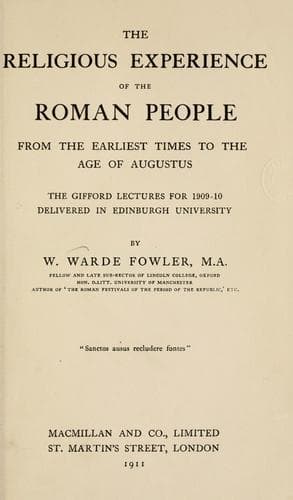
The Religious Experience of the Roman People: From the Earliest Times to the Age of AugustusFowler, W. Warde (William Warde)
Religion
The Religious Experience of the Roman People: From the Earliest Times to the Age of Augustus
Fowler, W. Warde (William Warde)
Cults -- Rome; Rome -- Religion
THE FIRST ARRIVAL OF NEW CULTS IN ROME
Recapitulation of foregoing lectures. Weak point of the
organised State religion: it discouraged individual
development. Its moral influence mainly a disciplinary
one; and it hypnotised the religious instinct.
Growth of a new population at end of regal period, also
of trade and industry. New deities from abroad represent
these changes: Hercules of Ara Maxima; Castor and
Pollux; Minerva. Diana of the Aventine reflects a new
relation with Latium. Question as to the real religious
influence of these deities. The Capitoline temple of
Jupiter, Juno, and Minerva, of Etruscan origin. Meaning
of cult-titles Optimus Maximus, and significance of this
great Jupiter in Roman religious experience 223-247
LECTURE XI
CONTACT OF THE OLD AND NEW IN RELIGION
Plan of this and following lectures. The formalised
Roman religion meets with perils, material and moral,
and ultimately proves inadequate. Subject of this
lecture, the introduction of Greek deities and rites;
but first a proof that the Romans were a really
religious people; evidence from literature, from
worship, from the practice of public life, and from
Latin religious vocabulary.
Temple of Ceres, Liber, Libera (Demeter, Dionysus,
Persephone); its importance for the date of Sibylline
influence at Rome. Nature of this influence; how and
when it reached Rome. The keepers of the "Sibylline
books"; new cults introduced by them. New rites:
lectisternia and supplicationes, their meaning and
historical importance 248-269
LECTURE XII
THE PONTIFICES AND THE SECULARISATION OF RELIGION
Historical facts about the Pontifices in this period; a
powerful exclusive "collegium" taking charge of the _ius
divinum_. The legal side of their work; they
administered the oldest rules of law, which belonged to
that _ius_. New ideas of law after Etruscan period;
increasing social complexity and its effect on legal
matters; result, publication of rules of law, civil and
religious, in XII. Tables, and abolition of legal
monopoly of Pontifices. But they keep control of (1)
procedure, (2) interpretation, till end of fourth
century B.C. Publication of Fasti and _Legis actiones_;
the college opened to Plebeians. Work of Pontifices in
third century: (1) admission of new deities, (2)
compilation of annals, (3) collection of religious
formulae. General result; formalisation of religion; and
secularisation of pontifical influence 270-291
LECTURE XIII
THE AUGURS AND THE ART OF DIVINATION
Public-domain text, read in full here on John Shaqi.
Reviews
Reviews
No reviews yet
Be the first to share your thoughts on this work.
Join the Discussion
Join the discussion
Sign in to leave a comment or review.
Sign InorCreate an account