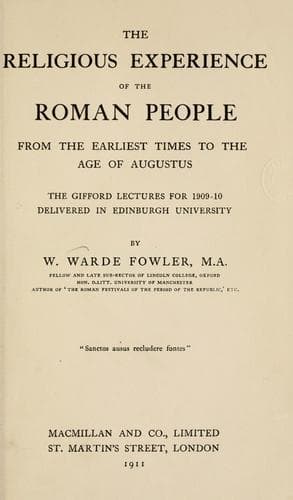
The Religious Experience of the Roman People: From the Earliest Times to the Age of AugustusFowler, W. Warde (William Warde)
Religion
The Religious Experience of the Roman People: From the Earliest Times to the Age of Augustus
Fowler, W. Warde (William Warde)
Cults -- Rome; Rome -- Religion
[92] See Schanz, _Gesch. der roem. Literatur_, vol. i.
(ed. 3) p. 270 foll.
[93] This fragment of Piso is preserved by Gellius, xi.
14. 1.
[94] See, _e.g._, Schanz, _Gesch. der roem. Literatur_,
vol. ii. p. 106.
[95] Wissowa, _l.c._ Aust in Roscher's _Lexicon_, _s.v._
"Iuppiter," p. 657.
[96] Cumont, _Religions Orientales dans le paganisme
romain_, ch. 5. I shall return to this subject in my
second course of lectures.
[97] Mueller-Deecke, _Etrusker_, ii. ch. vii., especially
p. 176 foll.
[98] Cp. below, Lecture XV.
[99] Pliny, _N.H._ xxviii. 13: "Vestales nostras hodie
credimus nondum egressa urbe mancipia fugitiva retinere
in loco precationibus."
[100] Plutarch, _Numa_, 10. Virginity would increase the
power of the spell; see Fehrle, _Die kultische
Keuschheit im Altertum_, p. 54 foll.
[101] See, _e.g._, Frazer, _G.B._ i. 360 foll.
[102] See _R.F._ p. 320, notes 6 and 7.
[103] Within the last thirty years or so the Lupercalia
has been discussed (apart from writers on classical
subjects exclusively) by Mannhardt in his _Mythologische
Studien_, p. 72 foll.; Robertson Smith, _Semites_, p.
459; Deubner in _Archiv_, 1910, p. 481 foll.; and at the
moment of writing by E. S. Hartland, _Primitive
Paternity_, i. ch. ii. _R.F._ p. 310 foll. See Appendix
D.
[104] This view was originally stated in Pauly-Wissowa,
_s.v._ "Argei." I endeavoured to confute it in the
_Classical Review_, 1902, p. 115 foll., and Wissowa
replied in _Gesammelte Abhandlungen_, p. 211 foll. Since
then my conviction has become stronger that this great
scholar is for once wrong. Ennius alluded to the Argei
as an institution of Numa, _i.e._ as primitive (frag.
121, Vahlen, from Festus p. 355, and Varro, _L.L._ vii.
44), yet Ennius was a youth at the very time when
Wissowa insists that the rite originated. Wissowa makes
no attempt to explain this. See below, p. 321 foll.
[105] _R.F._ p. 111 foll.
[106] _e.g._ the October horse, which also occurred on
the Ides; see _R.F._ p. 241 foll.; and the festival of
Anna Perenna, also on Ides (March 15), _R.F._ p. 50
foll. It is just possible that all the three festivals
were originally in the old calendar, and dropped out
because the mark of the Ides had to be affixed to the
day in the first place. See Wissowa, _Gesammelte
Abhandlungen_, p. 164 foll.; _R.F._ p. 241.
Public-domain text, read in full here on John Shaqi.
Reviews
Reviews
No reviews yet
Be the first to share your thoughts on this work.
Elsewhere in the archive
Join the Discussion
Join the discussion
Sign in to leave a comment or review.
Sign InorCreate an account