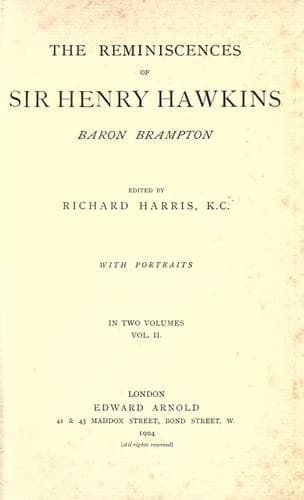
The Reminiscences of Sir Henry Hawkins (Baron Brampton)Brampton, Henry Hawkins, Baron
History
The Reminiscences of Sir Henry Hawkins (Baron Brampton)
Brampton, Henry Hawkins, Baron
Brampton, Henry Hawkins, Baron, 1817-1907; Judges -- Great Britain -- Biography
On December 28 he purchased from a chemist to whom he was a stranger,
and who lived at Thrapston, a quantity of poison, alleging that he
wanted to poison rats. Prisoner called in a gentleman as a reference
to his respectability, as the chemist had refused to sell him the
poison without. At last a small parcel was supplied. It was entered in
a book with the prisoner's name, and he signed the book, as did also
the gentleman who was his introducer. The poison was strychnine,
arsenic, prussic acid, and carbolic acid. No less than 90 grains of
strychnine were supplied. He had written to say he would come over on
the Friday which followed January 5. There is no reason to suppose he
did not fulfil his promise. On the Friday the woman was suffering from
neuralgia. In the evening, however, she was in her usual health and
spirits, and did her ironing up to eight o'clock. She went to bed
between half-past nine and ten, and took with her a tumbler of water.
In ten minutes the little girl and her brother went upstairs. They
went to the mother, who was in bed with her child. The tumbler was
nearly empty. The mother asked for a "sweet," which the little girl
gave. After this Annie got into bed; the mother began to twitch her
arms and legs, and seemed in great pain. Dr. Turner was sent for, as
she got worse. His assistant, Dr. Anderson, came, and, watching the
patient, noticed that the symptoms were those of strychnine poisoning.
She was dying. Before he could get to the surgery and return with an
antidote the woman was dead. She who had been well at half-past nine
was dead before eleven!
The police were communicated with, and a constable searched the house.
Turning up the valances of the bed, he found a piece of paper crumpled
up; this was sent to an analyst on the following day. An inquest was
held and a post-mortem directed.
Horsford at the inquest swore that he had never written to the
deceased or visited her.
On the evening of Saturday the 8th, after the post-mortem, Mrs.
Hensman and another woman found between the mattress and the bed a
packet of papers. These were also submitted for analysis. One of them
contained 35 grains of strychnine; another had crystals of strychnine
upon it. There was writing on one of the packets, and it was the
handwriting of the prisoner; it said, "Take in a little water; it is
quite harmless. Will come over in a day or two." On another packet was
written: "One dose; take as told," also in the prisoner's handwriting.
The body had been buried and was exhumed. Three grains of strychnine
were found by the county analyst in such parts of the stomach as were
submitted to him. Dr. Stevenson took other parts to London, and the
conclusion he came to was that at least 10 grains must have been in
the body at the time of death, while 1/2 grain has been known to be
fatal.
Public-domain text, read in full here on John Shaqi.
Reviews
Reviews
No reviews yet
Be the first to share your thoughts on this work.
Elsewhere in the archive
Join the Discussion
Join the discussion
Sign in to leave a comment or review.
Sign InorCreate an account