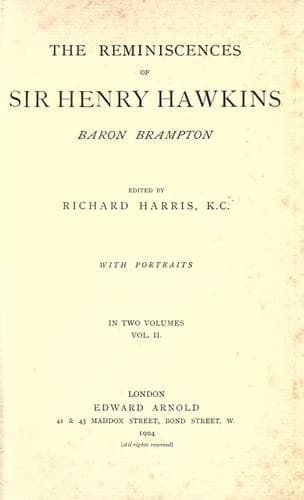
The Reminiscences of Sir Henry Hawkins (Baron Brampton)Brampton, Henry Hawkins, Baron
History
The Reminiscences of Sir Henry Hawkins (Baron Brampton)
Brampton, Henry Hawkins, Baron
Brampton, Henry Hawkins, Baron, 1817-1907; Judges -- Great Britain -- Biography
There was a singular circumstance in the defence of this case, one
which I have never heard before or since, and that was a complaint
that the counsel for the prisoner was "twitted" by the Crown because
he had not called _evidence for the defence_. The jury were solemnly
asked to remember that if one jot or tittle of evidence had been put
forward, or a single document put in by him, the prisoner's counsel,
he would _lose the last word on behalf of the prisoner_! Of course,
counsel's last word may be of more value than some evidence; but the
smallest "jot or tittle" of evidence, or any document whatever that
even _tends_ to prove the innocence of the accused, is of more value
than a thousand last words of the most powerful speaker I have ever
listened to. And I would go further and say that evidence in favour of
a prisoner should never be kept back for the sake of the last word.
It is the bounden duty of counsel to produce it, especially where
evidence is so strong that no speech could save the prisoner. Neither
side should keep back evidence in a prisoner's favour. I said to the
jury,--
"We are assembled in the presence of God to fulfil one of the most
solemn obligations it is possible to fulfil, and I will to the best of
my ability assist you to arrive at an honest and just conclusion.
"The law is that if a man deliberately or designedly administers, or
causes to be administered, a fatal poison to procure abortion, whether
the woman be pregnant or not, and she dies of it, the crime is wilful
murder.
"You have been asked to form a bad opinion of this deceased woman, but
she had brought up her children respectably on her slender means, and
there was no evidence that she was a loose woman. It more than
pained me when I heard the learned counsel--_instructed by the
prisoner_--cross-examine that poor little girl, left an orphan by the
death of the mother, with a view to creating an impression that the
poor dead creature was a person of shameless character.
"Again, counsel has commented in unkind terms on the deceased woman,
and said the prisoner _had no motive_ in committing this crime on a
woman whom he valued at half a crown.
"He might not, it is true, care half a crown for her. It is not a
question as to what he valued the woman at; we are not trying that at
all; but it showed there _was_ a motive.
Public-domain text, read in full here on John Shaqi.
Reviews
Reviews
No reviews yet
Be the first to share your thoughts on this work.
Elsewhere in the archive
Join the Discussion
Join the discussion
Sign in to leave a comment or review.
Sign InorCreate an account