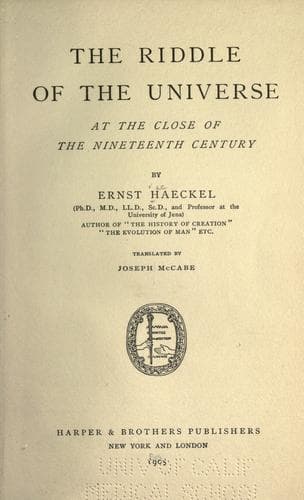
The Riddle of the Universe at the close of the nineteenth centuryHaeckel, Ernst
Religion
The Riddle of the Universe at the close of the nineteenth century
Haeckel, Ernst
Evolution; Monism; Religion and science; Soul
A number of eminent zoologists--Weismann being particularly
prominent--have recently defended the opinion that only the lowest
unicellular organisms, the protists, are immortal, in contradistinction
to the multicellular plants and animals, whose bodies are formed of
tissues. This curious theory is especially based on the fact that
most of the protists multiply without sexual means, by division or
the formation of spores. In such processes the whole body of the
unicellular organism breaks up into two or more equal parts (daughter
cells), and each of these portions completes itself by further growth
until it has the size and form of the mother cell. However, by the very
process of division the _individuality_ of the unicellular creature
has been destroyed; both its physiological and its morphological unity
have gone. The view of Weismann is logically inconsistent with the
very notion of _individual_--an "indivisible" entity; for it implies
a unity which cannot be divided without destroying its nature. In
this sense the unicellular protophyta and protozoa are throughout
life _physiological individuals_, just as much as the multicellular
tissue-plants and animals. A sexual propagation by simple division
is found in many of the multicellular species (for instance, in many
cnidaria, corals, medusæ, etc.); the mother animal, the division of
which gives birth to the two daughter animals, ceases to exist with
the segmentation. "The protozoa," says Weismann, "have no individuals
and no generations in the metazoic sense." I must entirely dissent
from his thesis. As I was the first to introduce the title of
_metazoa_, and oppose these multicellular, tissue-forming animals to
the unicellular _protozoa_ (infusoria, rhizopods, etc.), and as I was
the first to point out the essential difference in the development of
the two (the former from germinal layers, and the latter not), I must
protest that I consider the _protozoa_ to be just as mortal in the
physiological (and psychological) sense as the _metazoa_; neither body
nor soul is immortal in either group. The other erroneous consequences
of Weismann's notion have been refuted by Moebius (1884), who justly
remarks that "every event in the world is periodic," and that "there is
no source from which immortal organic individuals might have sprung."
Public-domain text, read in full here on John Shaqi.
Reviews
Reviews
No reviews yet
Be the first to share your thoughts on this work.
Elsewhere in the archive
Join the Discussion
Join the discussion
Sign in to leave a comment or review.
Sign InorCreate an account