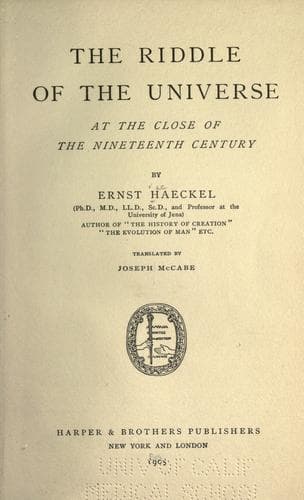
The Riddle of the Universe at the close of the nineteenth centuryHaeckel, Ernst
Religion
The Riddle of the Universe at the close of the nineteenth century
Haeckel, Ernst
Evolution; Monism; Religion and science; Soul
When we take the idea of immortality in the widest sense, and extend
it to the totality of the knowable universe, it has a scientific
significance; it is then not merely acceptable, but self-evident,
to the monistic philosopher. In that sense the thesis of the
indestructibility and eternal duration of all that exists is equivalent
to our supreme law of nature, the _law of substance_ (see chap. xii).
As we intend to discuss this immortality of the cosmos fully later on,
in establishing the theory of the persistence of matter and force,
we shall not dilate on it at present. We pass on immediately to the
criticism of that belief in immortality which is the only sense usually
attached to the word, the immortality of the individual soul. We
shall first inquire into the extent and the origin of this mystic and
dualistic notion, and point out, in particular, the wide acceptance
of the contradictory thesis, our monistic, empirically established
_thanatism_. I must distinguish two essentially different forms of
thanatism--primary and secondary; primary thanatism is the original
absence of the dogma of immortality (in the primitive uncivilized
races); secondary thanatism is the later outcome of a rational
knowledge of nature in the civilized intelligence.
We still find it asserted in philosophic, and especially in theological,
works that belief in the personal immortality of the human soul was
originally shared by all men--or, at least, by all "rational" men. That
is not the case. This dogma is not an original idea of the human mind,
nor has it ever found universal acceptance. It has been absolutely
proved by modern comparative ethnology that many uncivilized races
of the earliest and most primitive stage had no notion either of
immortality or of God. That is true, for instance, of the Veddahs of
Ceylon, those primitive pygmies whom, on the authority of the able
studies of the Sarasins, we consider to be a relic of the earliest
inhabitants of India;[22] it is also the case in several of the
earliest groups of the nearly related Dravidas, the Indian Seelongs,
and some native Australian races. Similarly, several of the primitive
branches of the American race, in the interior of Brazil, on the upper
Amazon, etc., have no knowledge either of gods or immortality. This
_primary_ absence of belief in immortality and deity is an extremely
important fact; it is, obviously, easy to distinguish from the
_secondary_ absence of such belief, which has come about in the highest
civilized races as the result of laborious critico-philosophical study.
Public-domain text, read in full here on John Shaqi.
Reviews
Reviews
No reviews yet
Be the first to share your thoughts on this work.
Elsewhere in the archive
Join the Discussion
Join the discussion
Sign in to leave a comment or review.
Sign InorCreate an account