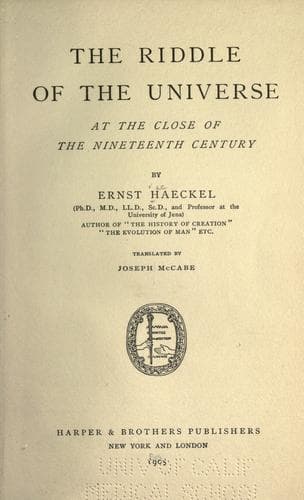
The Riddle of the Universe at the close of the nineteenth centuryHaeckel, Ernst
Religion
The Riddle of the Universe at the close of the nineteenth century
Haeckel, Ernst
Evolution; Monism; Religion and science; Soul
Differently from the primary thanatism which originally characterized
primitive man, and has always been widely spread, the _secondary_
absence of belief in immortality is only found at a late stage of
history: it is the ripe fruit of profound reflection on life and death,
the outcome of bold and independent philosophical speculation. We first
meet it in some of the Ionic philosophers of the sixth century B.C.,
then in the founders of the old materialistic philosophy, Democritus
and Empedocles, and also in Simonides and Epicurus, Seneca and Plinius,
and in an elaborate form in Lucretius Carus. With the spread of
Christianity at the decay of classical antiquity, athanatism, one of
its chief articles of faith, dominated the world, and so, amid other
forms of superstition, the myth of personal immortality came to be
invested with a high importance.
Naturally, through the long night of the Dark Ages it was rarely that
a brave free-thinker ventured to express an opinion to the contrary:
the examples of Galileo, Giordano Bruno, and other independent
philosophers, effectually destroyed all freedom of utterance. Heresy
only became possible when the Reformation and the Renaissance had
broken the power of the papacy. The history of modern philosophy tells
of the manifold methods by which the matured mind of man sought to
rid itself of the superstition of immortality. Still, the intimate
connection of the belief with the Christian dogma invested it with
such power, even in the more emancipated sphere of Protestantism,
that the majority of convinced free-thinkers kept their sentiments to
themselves. From time to time some distinguished scholar ventured to
make a frank declaration of his belief in the impossibility of the
continued life of the soul after death. This was done in France in the
second half of the eighteenth century by Voltaire, Danton, Mirabeau,
and others, and by the leaders of the materialistic school of those
days, Holbach, Lamettrie, etc. The same opinion was defended by the
able friend of the Materialists, the greatest of the Hohenzollerns, the
monistic "philosopher of Sans-souci." What would Frederick the Great,
the "crowned thanatist and atheist," say, could he compare his monistic
views with those of his successor of to-day?
Public-domain text, read in full here on John Shaqi.
Reviews
Reviews
No reviews yet
Be the first to share your thoughts on this work.
Elsewhere in the archive
Join the Discussion
Join the discussion
Sign in to leave a comment or review.
Sign InorCreate an account