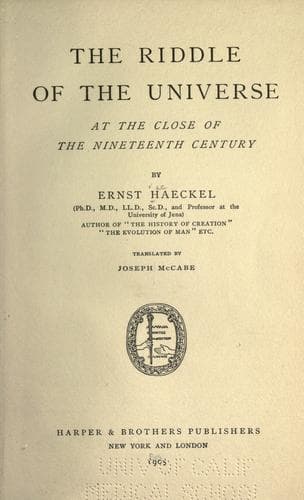
The Riddle of the Universe at the close of the nineteenth centuryHaeckel, Ernst
Religion
The Riddle of the Universe at the close of the nineteenth century
Haeckel, Ernst
Evolution; Monism; Religion and science; Soul
Among thoughtful physicians the conviction that the existence of the
soul came to an end at death has been common for centuries: generally,
however, they refrained from giving it expression. Moreover, the
empirical science of the brain remained so imperfect during the last
century that the soul could continue to be regarded as its mysterious
inhabitant. It was the gigantic progress of biology in the present
century, and especially in the latter half of the century, that
finally destroyed the myth. The establishment of the theory of descent
and the cellular theory, the astounding discoveries of ontogeny and
experimental physiology--above all, the marvellous progress of the
microscopic anatomy of the brain, gradually deprived athanatism of
every basis; now, indeed, it is rarely that an informed and honorable
biologist is found to defend the immortality of the soul. All the
monistic philosophers of the century (Strauss, Feuerbach, Büchner,
Spencer, etc.) are thanatists.
The dogma of personal immortality owes its great popularity and its
high importance to its intimate connection with the teaching of
Christianity. This circumstance gave rise to the erroneous and still
prevalent belief that the myth is a fundamental element of all the
higher religions. That is by no means the case. The higher Oriental
religions include no belief whatever in the immortality of the soul;
it is not found in Buddhism, the religion that dominates thirty per
cent. of the entire human race; it is not found in the ancient popular
religion of the Chinese, nor in the reformed religion of Confucius
which succeeded it; and, what is still more significant, it is not
found in the earlier and purer religion of the Jews. Neither in the
"five Mosaic books," nor in any of the writings of the Old Testament
which were written before the Babylonian Exile, is there any trace of
the notion of individual persistence after death.
Public-domain text, read in full here on John Shaqi.
Reviews
Reviews
No reviews yet
Be the first to share your thoughts on this work.
Elsewhere in the archive
Join the Discussion
Join the discussion
Sign in to leave a comment or review.
Sign InorCreate an account