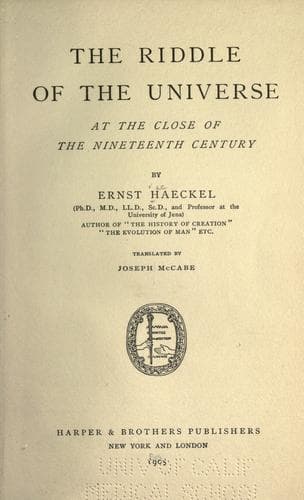
The Riddle of the Universe at the close of the nineteenth centuryHaeckel, Ernst
Religion
The Riddle of the Universe at the close of the nineteenth century
Haeckel, Ernst
Evolution; Monism; Religion and science; Soul
The mystic notion that the human soul will live forever after death has
had a polyphyletic origin. It was unknown to the earliest speaking man
(the hypothetical _homo primigenius_ of Asia), to his predecessors, of
course, the _pithecanthropus_ and _prothylobates_, and to the least
developed of his modern successors, the Veddahs of Ceylon, the Seelongs
of India, and other distant races. With the development of reason and
deeper reflection on life and death, sleep and dreams, mystic ideas of
a dualistic composition of our nature were evolved--independently of
each other--in a number of the earlier races. Very different influences
were at work in these polyphyletic creations--worship of ancestors,
love of relatives, love of life and desire of its prolongation, hope of
better conditions of life beyond the grave, hope of the reward of good
and punishment of evil deeds, and so forth. Comparative psychology has
recently brought to our knowledge a great variety of myths and legends
of that character; they are, for the most part, closely associated
with the oldest forms of theistic and religious belief. In most of the
modern religions athanatism is intimately connected with theism; the
majority of believers transfer their materialistic idea of a "personal
God" to their "immortal soul." That is particularly true of the
dominant religion of modern civilized states, Christianity.
As everybody knows, the dogma of the immortality of the soul has long
since assumed in the Christian religion that rigid form which it
has in the articles of faith: "I believe in the resurrection of the
body and in an eternal life." Man will arise on "the last day," as
Christ is alleged to have done on Easter morn, and receive a reward
according to the tenor of his earthly life. This typically Christian
idea is thoroughly materialistic and anthropomorphic; it is very little
superior to the corresponding crude legends of uncivilized peoples. The
impossibility of "the resurrection of the body" is clear to every man
who has some knowledge of anatomy and physiology. The resurrection of
Christ, which is celebrated every Easter by millions of Christians, is
as purely mythical as "the awakening of the dead," which he is alleged
to have taught. These mystic articles of faith are just as untenable in
the light of pure reason as the cognate hypothesis of "eternal life."
Public-domain text, read in full here on John Shaqi.
Reviews
Reviews
No reviews yet
Be the first to share your thoughts on this work.
Elsewhere in the archive
Join the Discussion
Join the discussion
Sign in to leave a comment or review.
Sign InorCreate an account