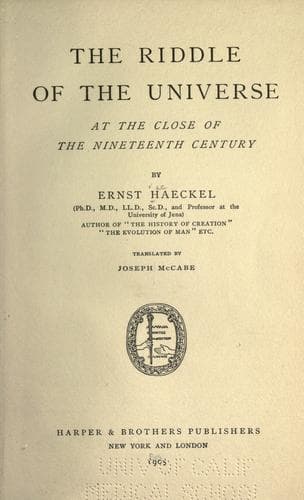
The Riddle of the Universe at the close of the nineteenth centuryHaeckel, Ernst
Religion
The Riddle of the Universe at the close of the nineteenth century
Haeckel, Ernst
Evolution; Monism; Religion and science; Soul
The fantastic notions which the Christian Church disseminates as to the
eternal life of the immortal soul after the dissolution of the body are
just as materialistic as the dogma of "the resurrection of the body."
In his interesting work on _Religion in the Light of the Darwinian
Theory_, Savage justly remarks: "It is one of the standing charges of
the Church against science that it is materialistic. I must say, in
passing, that the whole ecclesiastical doctrine of a future life has
always been, and still is, materialism of the purest type. It teaches
that the material body shall rise, and dwell in a material heaven." To
prove this one has only to read impartially some of the sermons and
ornate discourses in which the glory of the future life is extolled
as the highest good of the Christian, and belief in it is laid down to
be the foundation of morality. According to them, all the joys of the
most advanced modern civilization await the pious believer in Paradise,
while the "All-loving Father" reserves his eternal fires for the
godless materialist.
In opposition to the materialist athanatism, which is dominant in
the Christian and Mohammedan Churches, we have, apparently, a purer
and higher form of faith in the _metaphysical athanatism_, as taught
by most of our dualist and spiritualist philosophers. Plato must be
considered its chief creator: in the fourth century before Christ
he taught that complete dualism of body and soul which afterwards
became one of the most important, theoretically, and one of the most
influential, practically, of the Christian articles of faith. The
body is mortal, material, physical; the soul is immortal, immaterial,
metaphysical. They are only temporarily associated, for the course of
the individual life. As Plato postulated an eternal life before as well
as after this temporary association, he must be classed as an adherent
of "metempsychosis," or transmigration of souls; the soul existed as
such, or as an "eternal idea," before it entered into a human body.
When it quits one body it seeks such other as is most suited to its
character for its habitation. The souls of bloody tyrants pass into the
bodies of wolves and vultures, those of virtuous toilers migrate into
the bodies of bees and ants, and so forth. The childish naïvety of this
Platonic morality is obvious; on closer examination his views are found
to be absolutely incompatible with the scientific truth which we owe to
modern anatomy, physiology, histology, and ontogeny; we mention them
only because, in spite of their absurdity, they have had a profound
influence on thought and culture. On the one hand, the mysticism of the
Neo-Platonists, which penetrated into Christianity, attaches itself to
the psychology of Plato; on the other hand, it became subsequently one
of the chief supports of spiritualistic and idealistic philosophy. The
Platonic "idea" gave way in time to the notion of psychic "substance";
Public-domain text, read in full here on John Shaqi.
Reviews
Reviews
No reviews yet
Be the first to share your thoughts on this work.
Elsewhere in the archive
Join the Discussion
Join the discussion
Sign in to leave a comment or review.
Sign InorCreate an account