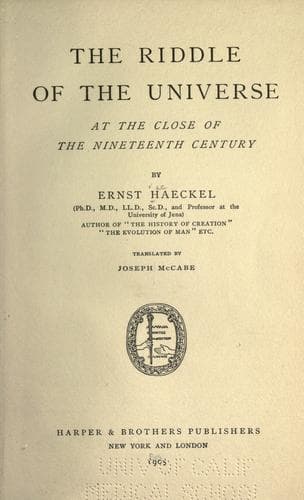
The Riddle of the Universe at the close of the nineteenth centuryHaeckel, Ernst
Religion
The Riddle of the Universe at the close of the nineteenth century
Haeckel, Ernst
Evolution; Monism; Religion and science; Soul
this is just as incomprehensible and metaphysical, though it often
assumed a physical appearance.
The conception of the soul as a "substance" is far from clear in many
psychologists; sometimes it is regarded as an "immaterial" entity of
a peculiar character in an abstract and idealistic sense, sometimes
in a concrete and realistic sense, and sometimes as a confused
_tertium quid_ between the two. If we adhere to the monistic idea of
substance, which we develop in chap. xii., and which takes it to be
the simplest element of our whole world-system, we find _energy_ and
_matter_ inseparably associated in it. We must, therefore, distinguish
in the "substance of the soul" the characteristic psychic _energy_
which is all we perceive (sensation, presentation, volition, etc.),
and the psychic _matter_, which is the inseparable basis of its
activity--that is, the living protoplasm. Thus, in the higher animals
the "matter" of the soul is a part of the nervous system; in the lower
nerveless animals and plants it is a part of their multicellular
protoplasmic body; and in the unicellular protists it is a part of
their protoplasmic cell-body. In this way we are brought once more
to the psychic organs, and to an appreciation of the fact that these
material organs are indispensable for the action of the soul; but the
soul itself is _actual_--it is the sum-total of their physiological
functions.
However, the idea of a specific "soul-substance" found in the
dualistic philosophers who admit such a thing is very different from
this. They conceive the immortal soul to be material, yet invisible,
and essentially different from the visible body which it inhabits.
Thus _invisibility_ comes to be regarded as a most important attribute
of the soul. Some, in fact, compare the soul with ether, and regard
it, like ether, as an extremely subtle, light, and highly elastic
material, an imponderable agency, that fills the intervals between the
ponderable particles of the living organism, others compare the soul
with the wind, and so give it a gaseous nature; and it is this simile
which first found favor with primitive peoples, and led in time to the
familiar dualistic conception. When a man died, the body remained as a
lifeless corpse, but the immortal soul "flew out of it with the last
breath."
Public-domain text, read in full here on John Shaqi.
Reviews
Reviews
No reviews yet
Be the first to share your thoughts on this work.
Elsewhere in the archive
Join the Discussion
Join the discussion
Sign in to leave a comment or review.
Sign InorCreate an account