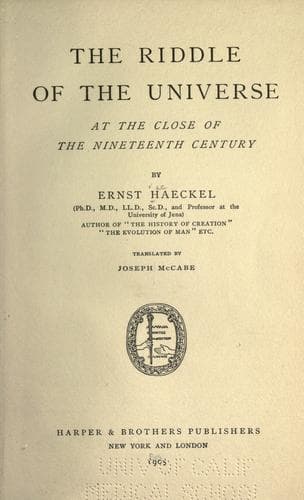
The Riddle of the Universe at the close of the nineteenth centuryHaeckel, Ernst
Religion
The Riddle of the Universe at the close of the nineteenth century
Haeckel, Ernst
Evolution; Monism; Religion and science; Soul
The comparison of the human soul with physical ether as a qualitatively
similar idea has assumed a more concrete shape in recent times through
the great progress of optics and electricity (especially in the last
decade); for these sciences have taught us a good deal about the
energy of ether, and enabled us to formulate certain conclusions as
to the material character of this all-pervading agency. As I intend
to describe these important discoveries later on (in chap. xii.), I
shall do no more at present than briefly point out that they render
the notion of an "etheric soul" absolutely untenable. Such an etheric
soul--that is a psychic substance--which is similar to physical ether,
and which, like ether, passes between the ponderable elements of the
living protoplasm or the molecules of the brain, cannot possibly
account for the individual life of the soul. Neither the mystic
notions of that kind which were warmly discussed about the middle
of the century, nor the attempts of modern "Neovitalists" to put
their mystical "vital force" on a line with physical ether, call for
refutation any longer.
Much more widespread, and still much respected, is the view which
ascribes a gaseous nature to the substance of the soul. The comparison
of human breath with the wind is a very old one; they were originally
considered to be identical, and were both given the same name. The
_anemos_ and _psyche_ of the Greeks, and the _anima_ and _spiritus_
of the Romans, were originally all names for "a breath of wind"; they
were transferred from this to the breath of man. After a time this
"living breath" was identified with the "vital force," and finally it
came to be regarded as the soul itself, or, in a narrower sense, as its
highest manifestation, the "spirit." From that the imagination went on
to derive the mystic notion of individual "spirits"; these, also, are
still usually conceived as "aëriform beings"--though they are credited
with the physiological functions of an organism, and they have been
photographed in certain well-known spiritist circles.
Public-domain text, read in full here on John Shaqi.
Reviews
Reviews
No reviews yet
Be the first to share your thoughts on this work.
Elsewhere in the archive
Join the Discussion
Join the discussion
Sign in to leave a comment or review.
Sign InorCreate an account