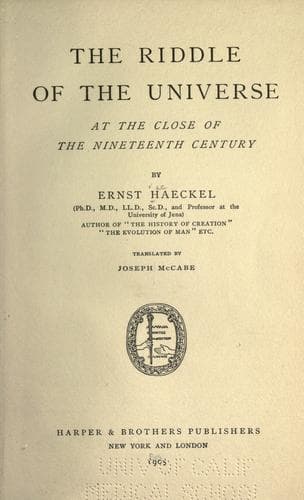
The Riddle of the Universe at the close of the nineteenth centuryHaeckel, Ernst
Religion
The Riddle of the Universe at the close of the nineteenth century
Haeckel, Ernst
Evolution; Monism; Religion and science; Soul
Experimental physics has succeeded, during the last decade of the
century, in reducing all gaseous bodies to a liquid--most of them,
also, to a solid--condition. Nothing more is needed than special
apparatus, which exerts a violent pressure on the gases at a very low
temperature. By this process not only the atmospheric elements, oxygen,
hydrogen, and nitrogen, but even compound gases (such as carbonic-acid
gas) and gaseous aggregates (like the atmosphere) have been changed
from gaseous to liquid form. In this way the "invisible" substances
have become "visible" to all, and in a certain sense "tangible."
With this transformation the mystic nimbus which formerly veiled
the character of the gas in popular estimation--as an invisible body
that wrought visible effects--has entirely disappeared. If, then, the
substance of the soul were really gaseous, it should be possible to
liquefy it by the application of a high pressure at a low temperature.
We could then catch the soul as it is "breathed out" at the moment of
death, condense it, and exhibit it in a bottle as "immortal fluid"
(_Fluidum animae immortale_). By a further lowering of temperature and
increase of pressure it might be possible to solidify it--to produce
"soul-snow." The experiment has not yet succeeded.
If athanatism were true, if, indeed, the human soul were to live for
all eternity, we should have to grant the same privilege to the souls
of the higher animals, at least to those of the nearest related mammals
(apes, dogs, etc.). For man is not distinguished from them by a special
_kind_ of soul, or by any peculiar and exclusive psychic function,
but only by a higher _degree_ of psychic activity, a superior stage
of development. In particular, consciousness--the function of the
association of ideas, thought, and reason--has reached a higher level
in many men (by no means in all) than in most of the animals. Yet this
difference is far from being so great as is popularly supposed; and it
is much slighter in every respect than the corresponding difference
between the higher and the lower animal souls, or even the difference
between the highest and the lowest stages of the human soul itself. If
we ascribe "personal immortality" to man, we are bound to grant it also
to the higher animals.
Public-domain text, read in full here on John Shaqi.
Reviews
Reviews
No reviews yet
Be the first to share your thoughts on this work.
Elsewhere in the archive
Join the Discussion
Join the discussion
Sign in to leave a comment or review.
Sign InorCreate an account