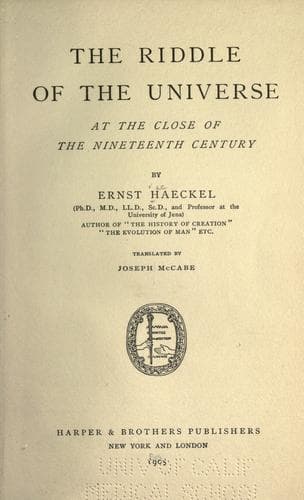
The Riddle of the Universe at the close of the nineteenth centuryHaeckel, Ernst
Religion
The Riddle of the Universe at the close of the nineteenth century
Haeckel, Ernst
Evolution; Monism; Religion and science; Soul
It is, therefore, quite natural that we should find this belief in
the immortality of the animal soul among many ancient and modern
peoples; we even meet it sometimes to-day in many thoughtful men
who postulate an "immortal life" for themselves, and have, at the
same time, a thorough empirical knowledge of the psychic life of the
animals. I once knew an old head-forester, who, being left a widower
and without children at an early age, had lived alone for more than
thirty years in a noble forest of East Prussia. His only companions
were one or two servants, with whom he exchanged merely a few necessary
words, and a great pack of different kinds of dogs, with which he
lived in perfect psychic communion. Through many years of training
this keen observer and friend of nature had penetrated deep into the
individual souls of his dogs, and he was as convinced of their personal
immortality as he was of his own. Some of his most intelligent dogs
were, in his impartial and objective estimation, at a higher stage of
psychic development than his old, stupid maid and the rough, wrinkled
manservant. Any unprejudiced observer, who will study the conscious
and intelligent psychic activity of a fine dog for a year, and follow
attentively the physiological processes of its thought, judgment,
and reason, will have to admit that it has just as valid a claim to
immortality as man himself.
The proofs of the immortality of the soul, which have been adduced for
the last two thousand years, and are, indeed, still credited with some
validity, have their origin, for the most part, not in an effort to
discover the truth, but in an alleged "necessity of emotion"--that is,
in imagination and poetic conceit. As Kant puts it, the immortality of
the soul is not an object of pure reason, but a "postulate of practical
reason." But we must set "practical reason" entirely aside, together
with all the "exigencies of emotion, or of moral education, etc.," when
we enter upon an honest and impartial pursuit of truth; for we shall
only attain it by the work of pure reason, starting from empirical
data and capable of logical analysis. We have to say the same of
athanatism as of theism; both are creations of poetic mysticism and of
transcendental "faith," not of rational science.
Public-domain text, read in full here on John Shaqi.
Reviews
Reviews
No reviews yet
Be the first to share your thoughts on this work.
Elsewhere in the archive
Join the Discussion
Join the discussion
Sign in to leave a comment or review.
Sign InorCreate an account