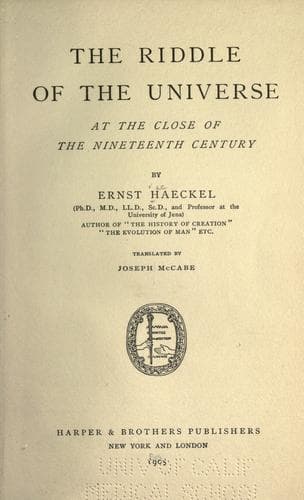
The Riddle of the Universe at the close of the nineteenth centuryHaeckel, Ernst
Religion
The Riddle of the Universe at the close of the nineteenth century
Haeckel, Ernst
Evolution; Monism; Religion and science; Soul
When we come to analyze all the different proofs that have been urged
for the immortality of the soul, we find that not a single one of them
is of a scientific character; not a single one is consistent with the
truths we have learned in the last few decades from physiological
psychology and the theory of descent. The _theological_ proof--that
a personal creator has breathed an immortal soul (generally regarded
as a portion of the divine soul) into man--is a pure myth. The
_cosmological_ proof--that the "moral order of the world" demands
the eternal duration of the human soul--is a baseless dogma. The
_teleological_ proof--that the "higher destiny" of man involves the
perfecting of his defective, earthly soul beyond the grave--rests
on a false anthropism. The _moral_ proof--that the defects and
the unsatisfied desires of earthly existence must be fulfilled by
"compensative justice" on the other side of eternity--is nothing
more than a pious wish. The _ethnological_ proof--that the belief in
immortality, like the belief in God, is an innate truth, common to
all humanity--is an error in fact. The _ontological_ proof--that the
soul, being a "simple, immaterial, and indivisible entity," cannot be
involved in the corruption of death--is based on an entirely erroneous
view of the psychic phenomena; it is a spiritualistic fallacy. All
these and similar "proofs of athanatism" are in a parlous condition;
they are definitely annulled by the scientific criticism of the last
few decades.
Public-domain text, read in full here on John Shaqi.
Reviews
Reviews
No reviews yet
Be the first to share your thoughts on this work.
Elsewhere in the archive
Join the Discussion
Join the discussion
Sign in to leave a comment or review.
Sign InorCreate an account