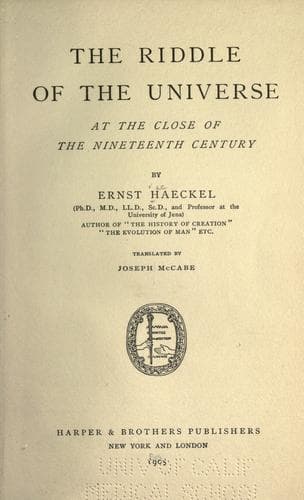
The Riddle of the Universe at the close of the nineteenth centuryHaeckel, Ernst
Religion
The Riddle of the Universe at the close of the nineteenth century
Haeckel, Ernst
Evolution; Monism; Religion and science; Soul
The extreme importance of the subject leads us to oppose to these
untenable "proofs of immortality" a brief exposition of the sound
scientific arguments against it. The _physiological_ argument shows
that the human soul is not an independent, immaterial substance, but,
like the soul of all the higher animals, merely a collective title
for the sum-total of man's cerebral functions; and these are just
as much determined by physical and chemical processes as any of the
other vital functions, and just as amenable to the law of substance.
The _histological_ argument is based on the extremely complicated
microscopic structure of the brain; it shows us the true "elementary
organs of the soul" in the ganglionic cells. The _experimental_
argument proves that the various functions of the soul are bound up
with certain special parts of the brain, and cannot be exercised unless
these are in a normal condition; if the areas are destroyed, their
function is extinguished; and this is especially applicable to the
"organs of thought," the four central instruments of mental activity.
The _pathological_ argument is the complement of the physiological;
when certain parts of the brain (the centres of speech, sight,
hearing, etc.) are destroyed by sickness, their activity (speech,
vision, hearing, etc.) disappears; in this way nature herself makes
the decisive physiological experiment. The _ontogenetic_ argument
puts before us the facts of the development of the soul in the
individual; we see how the child-soul gradually unfolds its various
powers; the youth presents them in full bloom, the mature man shows
their ripe fruit; in old age we see the gradual decay of the psychic
powers, corresponding to the senile degeneration of the brain. The
_phylogenetic_ argument derives its strength from palæontology, and the
comparative anatomy and physiology of the brain; co-operating with and
completing each other, these sciences prove to the hilt that the human
brain (and, consequently, its function--the soul) has been evolved step
by step from that of the mammal, and, still further back, from that of
the lower vertebrate.
Public-domain text, read in full here on John Shaqi.
Reviews
Reviews
No reviews yet
Be the first to share your thoughts on this work.
Elsewhere in the archive
Join the Discussion
Join the discussion
Sign in to leave a comment or review.
Sign InorCreate an account