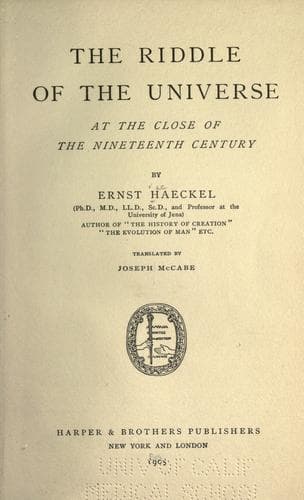
The Riddle of the Universe at the close of the nineteenth centuryHaeckel, Ernst
Religion
The Riddle of the Universe at the close of the nineteenth century
Haeckel, Ernst
Evolution; Monism; Religion and science; Soul
These inquiries, which might be supplemented by many other results of
modern science, prove the old dogma of the immortality of the soul
to be absolutely untenable; in the twentieth century it will not be
regarded as a subject of serious scientific research, but will be left
wholly to transcendental "faith." The "critique of pure reason" shows
this treasured faith to be a mere _superstition_, like the belief in a
personal God which generally accompanies it. Yet even to-day millions
of "believers"--not only of the lower, uneducated masses, but even of
the most cultured classes--look on this superstition as their dearest
possession and their most "priceless treasure." It is, therefore,
necessary to enter more deeply into the subject, and--assuming it to
be true--to make a critical inquiry into its practical value. It soon
becomes apparent to the impartial critic that this value rests, for
the most part, on fancy, on the want of clear judgment and consecutive
thought. It is my firm and honest conviction that a definitive
abandonment of these "athanatist illusions" would involve no painful
loss, but an inestimable positive gain for humanity.
Man's "emotional craving" clings to the belief on immortality for two
main reasons: firstly, in the hope of better conditions of life beyond
the grave; and, secondly, in the hope of seeing once more the dear
and loved ones whom death has torn from us. As for the first hope,
it corresponds to a natural feeling of the justice of compensation,
which is quite correct subjectively, but has no objective validity
whatever. We make our claim for an indemnity for the unnumbered defects
and sorrows of our earthly existence, without the slightest real
prospect or guarantee of receiving it. We long for an eternal life in
which we shall meet no sadness and no pain, but an unbounded peace
and joy. The pictures that most men form of this blissful existence
are extremely curious; the immaterial soul is placed in the midst of
grossly material pleasures. The imagination of each believer paints
the enduring splendor according to his personal taste. The American
Indian, whose athanatism Schiller has so well depicted, trusts to
find in his Paradise the finest hunting-grounds with innumerable
hordes of buffaloes and bears; the Eskimo looks forward to sun-tipped
icebergs with an inexhaustible supply of bears, seals, and other polar
animals; the effeminate Cingalese frames his Paradise on the wonderful
island-paradise of Ceylon with its noble gardens and forests--adding
that there will be unlimited supplies of rice and curry, of cocoanuts
and other fruit, always at hand; the Mohammedan Arab believes it will
be a place of shady gardens of flowers, watered by cool springs, and
filled with lovely maidens; the Catholic fisherman of Sicily looks
forward to a daily superabundance of the most valuable fishes and the
finest macaroni, and eternal absolution for all his sins, which he
Public-domain text, read in full here on John Shaqi.
Reviews
Reviews
No reviews yet
Be the first to share your thoughts on this work.
Elsewhere in the archive
Join the Discussion
Join the discussion
Sign in to leave a comment or review.
Sign InorCreate an account