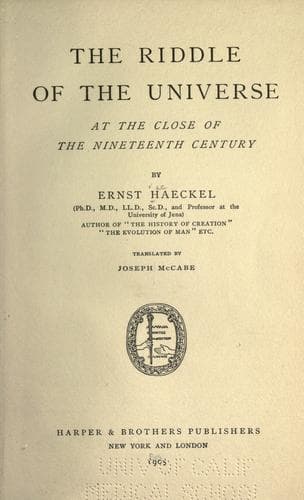
The Riddle of the Universe at the close of the nineteenth centuryHaeckel, Ernst
Religion
The Riddle of the Universe at the close of the nineteenth century
Haeckel, Ernst
Evolution; Monism; Religion and science; Soul
can go on committing in his eternal home; the evangelical of North
Europe longs for an immense Gothic cathedral, in which he can chant
the praises of the Lord of Hosts for all eternity. In a word, each
believer really expects his eternal life to be a direct continuation
of his individual life on earth, only in a "much improved and enlarged
edition."
We must lay special stress on the thoroughly materialistic character
of _Christian_ athanatism, which is closely connected with the absurd
dogma of the "resurrection of the body." As thousands of paintings of
famous masters inform us, the bodies that have risen again, with the
souls that have been born again, walk about in heaven just as they did
in this vale of tears; they see God with their eyes, they hear His
voice with their ears, they sing hymns to His praise with their larynx,
and so forth. In fine, the modern inhabitants of the Christian Paradise
have the same dual character of body and soul, the same organs of an
earthly body, as our ancient ancestors had in Odin's Hall in Walhalla,
as the "immortal" Turks and Arabs have in Mohammed's lovely gardens, as
the old Greek demi-gods and heroes had in the enjoyment of nectar and
ambrosia at the table of Zeus.
But, however gloriously we may depict this eternal life in Paradise,
it remains _endless_ in duration. Do we realize what "eternity"
means?--the uninterrupted continuance of our individual life forever!
The profound legend of the "wandering Jew," the fruitless search for
rest of the unhappy Ahasuerus, should teach us to appreciate such
an "eternal life" at its true value. The best we can desire after a
courageous life, spent in doing good according to our light, is the
eternal peace of the grave. "Lord, give them an eternal rest."
Any impartial scholar who is acquainted with geological calculations
of time, and has reflected on the long series of millions of years the
organic history of the earth has occupied, must admit that the crude
notion of an eternal life is not a _comfort_, but a fearful _menace_,
to the best of men. Only want of clear judgment and consecutive thought
can dispute it.
Public-domain text, read in full here on John Shaqi.
Reviews
Reviews
No reviews yet
Be the first to share your thoughts on this work.
Elsewhere in the archive
Join the Discussion
Join the discussion
Sign in to leave a comment or review.
Sign InorCreate an account