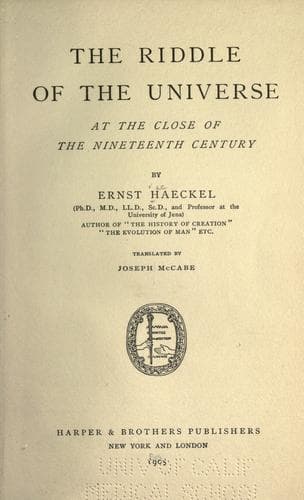
The Riddle of the Universe at the close of the nineteenth centuryHaeckel, Ernst
Religion
The Riddle of the Universe at the close of the nineteenth century
Haeckel, Ernst
Evolution; Monism; Religion and science; Soul
(moving force) are but two inseparable attributes of the one underlying
substance.
Among the various modifications which the fundamental idea of substance
has undergone in modern physics, in association with the prevalent
atomism, we shall select only two of the most divergent theories for
a brief discussion, the kinetic and the pyknotic. Both theories agree
that we have succeeded in reducing all the different forces of nature
to one common original force; gravity and chemical action, electricity
and magnetism, light and heat, etc., are only different manifestations,
forms, or _dynamodes_, of a single primitive force (_prodynamis_).
This fundamental force is generally conceived as a vibratory motion
of the smallest particles of matter--a vibration of atoms. The atoms
themselves, according to the usual "kinetic theory of substance," are
dead, separate particles of matter, which dance to and fro in empty
space and act at a distance. The real founder and most distinguished
representative of the kinetic theory is Newton, the famous discoverer
of the law of gravitation. In his great work, the _Philosophiae
Naturalis Principia Mathematica_ (1687), he showed that throughout the
universe the same law of attraction controls the unvarying constancy of
gravitation; the attraction of two particles being in direct proportion
to their mass and in inverse proportion to the square of their
distance. This universal force of gravity is at work in the fall of
an apple and the tidal wave no less than in the course of the planets
round the sun and the movements of all the heavenly bodies. Newton
had the immortal merit of establishing the law of gravitation and
embodying it in an indisputable mathematical formula. Yet this _dead
mathematical formula_, on which most scientists lay great stress, as so
frequently happens, gives us merely the _quantitative_ demonstration
of the theory; it gives us no insight whatever into the _qualitative_
nature of the phenomena. The action at a distance without a medium,
which Newton deduced from his law of gravitation, and which became one
of the most serious and most dangerous dogmas of later physics, does
not afford the slightest explanation of the real causes of attraction;
indeed, it long obstructed our way to the real discovery of them. I
cannot but suspect that his speculations on this mysterious action at a
distance contributed not a little to the leading of the great English
mathematician into the obscure labyrinth of mystic dreams and theistic
superstition in which he passed the last thirty-four years of his
life; we find him, at the end, giving metaphysical hypotheses on the
predictions of Daniel and on the paradoxical fantasies of St. John.
Public-domain text, read in full here on John Shaqi.
Reviews
Reviews
No reviews yet
Be the first to share your thoughts on this work.
Elsewhere in the archive
Join the Discussion
Join the discussion
Sign in to leave a comment or review.
Sign InorCreate an account