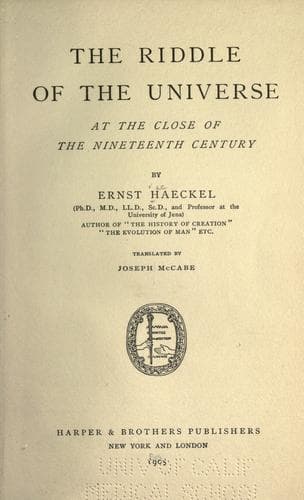
The Riddle of the Universe at the close of the nineteenth centuryHaeckel, Ernst
Religion
The Riddle of the Universe at the close of the nineteenth century
Haeckel, Ernst
Evolution; Monism; Religion and science; Soul
In fundamental opposition to the theory of vibration, or the kinetic
theory of substance, we have the modern "theory of condensation,"
or the pyknotic theory of substance. It is most ably established
in the suggestive work of J. C. Vogt on _The Nature of Electricity
and Magnetism on the Basis of a Simplified Conception of Substance_
(1891). Vogt assumes the primitive force of the world, the universal
_prodynamis_, to be, not the vibration or oscillation of particles in
empty space, but the condensation of a simple primitive substance,
which fills the infinity of space in an unbroken continuity. Its
sole inherent mechanical form of activity consists in a tendency to
condensation or contraction, which produces infinitesimal centres
of condensation; these may change their degree of thickness, and,
therefore, their volume, but are constant as such. These minute parts
of the universal substance, the centres of condensation, which might
be called _pyknatoms_, correspond in general to the ultimate separate
atoms of the kinetic theory; they differ, however, very considerably in
that they are credited with sensation and inclination (or will-movement
of the simplest form), _with souls_, in a certain sense--in harmony
with the old theory of Empedocles of the "love and hatred of the
elements." Moreover, these "atoms with souls" do not float in empty
space, but in the continuous, extremely attenuated intermediate
substance, which represents the uncondensed portion of the primitive
matter. By means of certain "constellations, centres of perturbation,
or systems of deformation," great masses of centres of condensation
quickly unite in immense proportions, and so obtain a preponderance
over the surrounding masses. By that process the primitive substance,
which in its original state of quiescence had the same mean consistency
throughout, divides or differentiates into two kinds. The centres
of disturbance, which _positively_ exceed the mean consistency in
virtue of the _pyknosis_ or condensation, form the ponderable matter
of bodies; the finer, intermediate substance, which occupies the space
between them, and _negatively_ falls below the mean consistency, forms
the ether, or imponderable matter. As a consequence of this division
into mass and ether there ensues a ceaseless struggle between the two
antagonistic elements, and this struggle is the source of all physical
processes. The positive ponderable matter, the element with the feeling
of like or desire, is continually striving to complete the process of
condensation, and thus collecting an enormous amount of _potential_
energy; the negative, imponderable matter, on the other hand, offers a
perpetual and equal resistance to the further increase of its strain
and of the feeling of dislike connected therewith, and thus gathers the
utmost amount of _actual_ energy.
Public-domain text, read in full here on John Shaqi.
Reviews
Reviews
No reviews yet
Be the first to share your thoughts on this work.
Elsewhere in the archive
Join the Discussion
Join the discussion
Sign in to leave a comment or review.
Sign InorCreate an account