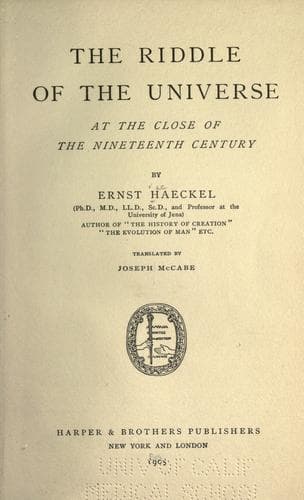
The Riddle of the Universe at the close of the nineteenth centuryHaeckel, Ernst
Religion
The Riddle of the Universe at the close of the nineteenth century
Haeckel, Ernst
Evolution; Monism; Religion and science; Soul
We cannot go any further here into the details of the brilliant
theory of J. C. Vogt. The interested reader cannot do better than
have recourse to the second volume of the above work for a clear,
popular exposition of the difficult problem. I am myself too little
informed in physics and mathematics to enter into a critical discussion
of its lights and shades; still, I think that this pyknotic theory
of substance will prove more acceptable to every biologist who is
convinced of the unity of nature than the kinetic theory which prevails
in physics to-day. A misunderstanding may easily arise from the fact
that Vogt puts his process of condensation in explicit contradiction
with the general phenomenon of motion; but it must be remembered that
he is speaking of vibratory movement in the sense of the physicist. His
hypothetical "condensation" is just as much determined by a movement
of substance as is the hypothetical "vibration"; only the kind of
movement and the relation of the moving elements are very different in
the two hypotheses. Moreover, it is not the whole theory of vibration,
but only an important section of it, that is contradicted by the theory
of condensation.
Modern physics, for the most part, still firmly adheres to the older
theory of vibration, to the idea of an _actio in distans_ and the
eternal vibration of dead atoms in empty space; it rejects the pyknotic
theory. Although Vogt's theory may be still far from perfect, and his
original speculations may be marred by many errors, yet I think he has
rendered a very good service in eliminating the untenable principles
of the kinetic theory of substance. As to my own opinion--and that of
many other scientists--I must lay down the following theses, which
are involved in Vogt's pyknotic theory, as indispensable for a truly
monistic view of substance, and one that covers the whole field of
organic and inorganic nature:
I. The two fundamental forms of substance, ponderable matter and ether,
are not dead and only moved by extrinsic force, but they are endowed
with sensation and will (though, naturally, of the lowest grade); they
experience an inclination for condensation, a dislike of strain; they
strive after the one and struggle against the other.
II. There is no such thing as empty space; that part of space which is
not occupied with ponderable atoms is filled with ether.
III. There is no such thing as an action at a distance through
perfectly empty space; all action of bodies upon each other is either
determined by immediate contact or is effected by the mediation of
ether.
Public-domain text, read in full here on John Shaqi.
Reviews
Reviews
No reviews yet
Be the first to share your thoughts on this work.
Elsewhere in the archive
Join the Discussion
Join the discussion
Sign in to leave a comment or review.
Sign InorCreate an account