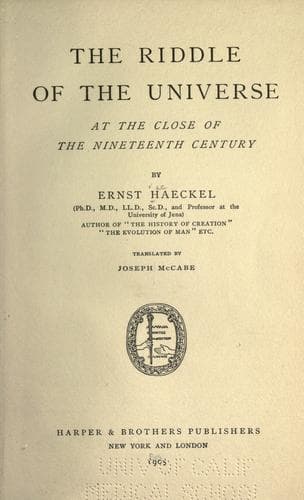
The Riddle of the Universe at the close of the nineteenth centuryHaeckel, Ernst
Religion
The Riddle of the Universe at the close of the nineteenth century
Haeckel, Ernst
Evolution; Monism; Religion and science; Soul
Both the theories of substance which we have just contrasted are
_monistic_ in principle, since the opposition between the two
conditions of substance--mass and ether--is not original; moreover,
they involve a continuous immediate contact and reciprocal action
of the two elements. It is otherwise with the _dualistic_ theories
of substance which still obtain in the idealist and spiritualist
philosophy, and which have the support of a powerful theology, in so
far as theology indulges in such metaphysical speculations. These
theories draw a distinction between two entirely different kinds of
substance, material and immaterial. Material substance enters into
the composition of the bodies which are the object of physics and
chemistry; the law of the persistence of matter and force is confined
to this world (apart from a belief in its "creation from nothing"
and other miracles). Immaterial substance is found in the "spiritual
world" to which the law does not extend; in this province the laws
of physics and chemistry are either entirely inapplicable or they
are subordinated to a "vital force," or a "free will," or a "divine
omnipotence," or some other phantom which is beyond the ken of critical
science. In truth, these profound errors need no further refutation
to-day, for experience has never yet discovered for us a single
immaterial substance, a single force which is not dependent on matter,
or a single form of energy which is not exerted by material movement,
whether it be of mass, or of ether, or of both. Even the most elaborate
and most perfect forms of energy that we know--the psychic life of
the higher animals, the thought and reason of man--depend on material
processes, or changes in the neuroplasm of the ganglionic cells; they
are inconceivable apart from such modifications. I have already shown
(chap. xi.) that the physiological hypothesis of a special, immaterial
"soul-substance" is untenable.
Public-domain text, read in full here on John Shaqi.
Reviews
Reviews
No reviews yet
Be the first to share your thoughts on this work.
Elsewhere in the archive
Join the Discussion
Join the discussion
Sign in to leave a comment or review.
Sign InorCreate an account