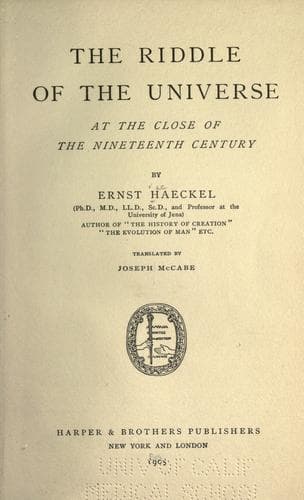
The Riddle of the Universe at the close of the nineteenth centuryHaeckel, Ernst
Religion
The Riddle of the Universe at the close of the nineteenth century
Haeckel, Ernst
Evolution; Monism; Religion and science; Soul
"The great question of the nature of ether," as Hertz justly calls
it, includes the question of its relation to ponderable matter; for
these two forms of matter are not only always in the closest external
contact, but also in eternal, dynamic, reciprocal action. We may divide
the most general phenomena of nature, which are distinguished by
physics as natural forces or "functions of matter," into two groups;
the first of them may be regarded mainly (though not exclusively) as a
function of ether, and the second a function of ponderable matter--as
in the following scheme which I take from my _Monism_:
THE WORLD (NATURE, OR THE COSMOS)
---------------------------------+-------------------------------------
ETHER--Imponderable. | MASS--Ponderable.
---------------------------------+-------------------------------------
|
1. _Consistency_: | 1. _Consistency_:
|
Etheric (_i.e._, neither | Not etheric (but gaseous, fluid,
gaseous nor fluid, nor solid). | or solid).
|
2. _Structure_: | 2. _Structure_:
|
Not atomistic, not made up of | Atomistic, made up of infinitesimal,
separate particles (atoms), but | distinct particles (atoms)
continuous. | discontinuous.
|
3. _Chief Functions_: | 3. _Chief Functions_:
|
Light, radiant heat, electricity,| Gravity, inertia, molecular heat,
and magnetism. | and chemical affinity.
---------------------------------+-------------------------------------
The two groups of functions of matter, which we have opposed in this
table, may, to some extent, be regarded as the outcome of the first
"division of labor" in the development of matter, the "primary ergonomy
of matter." But this distinction must not be supposed to involve an
absolute separation of the two antithetic groups; they always retain
their connection, and are in constant reciprocal action. It is well
known that the optical and electrical phenomena of ether are closely
connected with mechanical and chemical changes in ponderable elements;
the radiant heat of ether may be directly converted into the mechanical
heat of the mass; gravitation is impossible unless the ether effects
the mutual attraction of the separated atoms, because we cannot admit
the idea of an _actio in distans_. In like manner, the conversion
of one form of energy into another, as indicated in the law of the
persistence of force, illustrates the constant reciprocity of the two
chief types of substance, ether and mass.
Public-domain text, read in full here on John Shaqi.
Reviews
Reviews
No reviews yet
Be the first to share your thoughts on this work.
Elsewhere in the archive
Join the Discussion
Join the discussion
Sign in to leave a comment or review.
Sign InorCreate an account