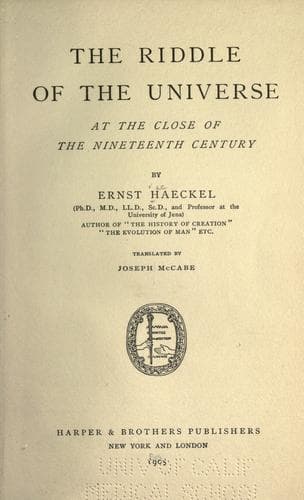
The Riddle of the Universe at the close of the nineteenth centuryHaeckel, Ernst
Religion
The Riddle of the Universe at the close of the nineteenth century
Haeckel, Ernst
Evolution; Monism; Religion and science; Soul
The great law of nature, which, under the title of the "law of
substance," we put at the head of all physical considerations, was
conceived as the law of "the persistence of force" by Robert Meyer, who
first formulated it, and Helmholtz, who continued the work. Another
German scientist, Friedrich Mohr, of Bonn, had clearly outlined it in
its main features ten years earlier (1837). The old idea of _force_
was, after a time, differentiated by modern physics from that of
_energy_, which was at first synonymous with it. Hence the law is
now usually called the "law of the persistence of energy." However,
this finer distinction need not enter into the general consideration,
to which I must confine myself here, and into the question of the
great principle of the "persistence of substance." The interested
reader will find a very clear treatment of the question in Tyndall's
excellent paper on "The Fundamental Law of Nature," in his _Fragments
of Science_. It fully explains the broad significance of this profound
cosmic law, and points out its application to the main problems of
very different branches of science. We shall confine our attention to
the important fact that the "principle of energy" and the correlative
idea of the unity of natural forces, on the basis of a common origin,
are now accepted by all competent physicists, and are regarded as the
greatest advance of physics in the nineteenth century. We now know that
heat, sound, light, chemical action, electricity, and magnetism are all
modes of motion. We can, by a certain apparatus, convert any one of
these forces into another, and prove by an accurate measurement that
not a single particle of energy is lost in the process.
The sum-total of force or energy in the universe remains constant, no
matter what changes take place around us; it is eternal and infinite,
like the matter on which it is inseparably dependent. The whole drama
of nature apparently consists in an alternation of movement and
repose; yet the bodies at rest have an inalienable quantity of force,
just as truly as those that are in motion. It is in this movement
that the potential energy of the former is converted into the kinetic
energy of the latter. "As the principle of the persistence of force
takes into account repulsion as well as attraction, it affirms that
the mechanical value of the potential energy and the kinetic energy
in the material world is a constant quantity. To put it briefly, the
force of the universe is divided into two parts, which may be mutually
converted, according to a fixed relation of value. The diminution of
the one involves the increase of the other; the total value remains
unchanged in the universe." The potential energy and the actual, or
kinetic, energy are being continually transformed from one condition to
the other; but the infinite sum of force in the world at large never
suffers the slightest curtailment.
Public-domain text, read in full here on John Shaqi.
Reviews
Reviews
No reviews yet
Be the first to share your thoughts on this work.
Elsewhere in the archive
Join the Discussion
Join the discussion
Sign in to leave a comment or review.
Sign InorCreate an account