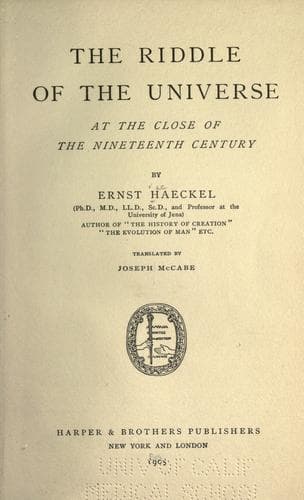
The Riddle of the Universe at the close of the nineteenth centuryHaeckel, Ernst
Religion
The Riddle of the Universe at the close of the nineteenth century
Haeckel, Ernst
Evolution; Monism; Religion and science; Soul
Once modern physics had established the law of substance as far as
the simpler relations of inorganic bodies are concerned, physiology
took up the story, and proved its application to the entire province
of the organic world. It showed that all the vital activities of the
organism--without exception--are based on a constant "reciprocity
of force" and a correlative change of material, or metabolism, just
as much as the simplest processes in "lifeless" bodies. Not only
the growth and the nutrition of plants and animals, but even their
functions of sensation and movement, their sense-action and psychic
life, depend on the conversion of potential into kinetic energy,
and _vice versâ_. This supreme law dominates also those elaborate
performances of the nervous system which we call, in the higher animals
and man, "the action of the mind."
Our monistic view, that the great cosmic law applies throughout the
whole of nature, is of the highest moment. For it not only involves,
on its positive side, the essential unity of the cosmos and the
causal connection of all phenomena that come within our cognizance,
but it also, in a negative way, marks the highest intellectual
progress, in that it definitely rules out the three central dogmas of
metaphysics--God, freedom, and immortality. In assigning mechanical
causes to phenomena everywhere, the law of substance comes into line
with the universal law of causality.
CHAPTER XIII
THE EVOLUTION OF THE WORLD
The Notion of Creation--Miracles--Creation of the Whole Universe
and of its Various Parts--Creation of Substance (Cosmological
Creation)--Deism: One Creative Day--Creation of Separate
Entities--Five Forms of Ontological Creationism--Theory of
Evolution--I. Monistic Cosmogony--Beginning and End of the
World--The Infinity and Eternity of the Universe--Space and
Time--_Universum perpetuum mobile_--Entropy of the Universe--II.
Monistic Geogeny--History of the Inorganic and Organic Worlds--III.
Monistic Biogeny--Transformism and the Theory of Descent: Lamarck
and Darwin--IV. Monistic Anthropogeny--Origin of Man
Public-domain text, read in full here on John Shaqi.
Reviews
Reviews
No reviews yet
Be the first to share your thoughts on this work.
Elsewhere in the archive
Join the Discussion
Join the discussion
Sign in to leave a comment or review.
Sign InorCreate an account