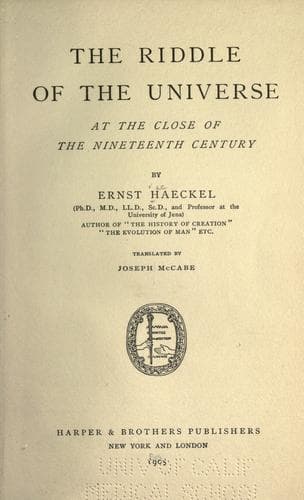
The Riddle of the Universe at the close of the nineteenth centuryHaeckel, Ernst
Religion
The Riddle of the Universe at the close of the nineteenth century
Haeckel, Ernst
Evolution; Monism; Religion and science; Soul
In our opinion, this second "world-enigma" is solved by the recognition
that movement is as innate and original a property of substance as
is sensation. The proof of this monistic assumption is found, first,
in the law of substance, and, secondly, in the discoveries which
astronomy and physics have made in the latter half of the century. By
the spectral analysis of Bunsen and Kirchhoff (1860) we have found, not
only that the millions of bodies, which fill the infinity of space, are
of the same material as our own sun and earth, but also that they are
in various stages of evolution; we have obtained by its aid information
as to the movements and distances of the stars, which the telescope
would never have given us. Moreover, the telescope itself has been
vastly improved, and has, in alliance with photography, made a host
of scientific discoveries of which no one dreamed at the beginning
of the century. In particular, a closer acquaintance with comets,
meteorites, star-clusters, and nebulæ has helped us to realize the
great significance of the smaller bodies which are found in millions in
the space between the stars.
We now know that the _paths_ of the millions of heavenly bodies are
_changeable_, and to some extent irregular, whereas the planetary
system was formerly thought to be constant, and the rotating spheres
were described as pursuing their orbits in eternal regularity.
Astro-physics owes much of its triumph to the immense progress of other
branches of physics, of optics, and electricity, and especially of
the theory of ether. And here, again, our supreme law of substance is
found to be one of the most valuable achievements of modern science.
We now know that it rules unconditionally in the most distant reaches
of space, just as it does in our planetary system, in the most minute
particle of the earth as well as in the smallest cell of our human
frame. We are, moreover, justified in concluding, if we are not
logically compelled to conclude, that the persistence of matter and
force has held good throughout all time as it does to-day. Through all
eternity the infinite universe has been, and is, subject to the law of
substance.
From this great progress of astronomy and physics, which mutually
elucidate and supplement each other, we draw a series of most important
conclusions with regard to the constitution and evolution of the
cosmos, and the persistence and transformation of substance. Let us put
them briefly in the following theses:
I. The _extent_ of the universe is infinite and unbounded; it is empty
in no part, but everywhere filled with substance.
II. The _duration_ of the world is equally infinite and unbounded; it
has no beginning and no end: it is eternity.
III. Substance is everywhere and always in uninterrupted movement and
transformation: nowhere is there perfect repose and rigidity; yet the
infinite quantity of matter and of eternally changing force remains
constant.
Public-domain text, read in full here on John Shaqi.
Reviews
Reviews
No reviews yet
Be the first to share your thoughts on this work.
Elsewhere in the archive
Join the Discussion
Join the discussion
Sign in to leave a comment or review.
Sign InorCreate an account