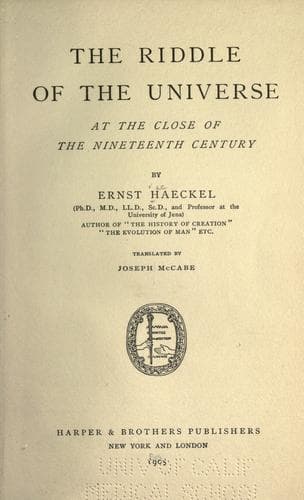
The Riddle of the Universe at the close of the nineteenth centuryHaeckel, Ernst
Religion
The Riddle of the Universe at the close of the nineteenth century
Haeckel, Ernst
Evolution; Monism; Religion and science; Soul
IV. This universal movement of substance in space takes the form of an
eternal cycle or of a periodical process of evolution.
V. The phases of this evolution consist in a periodic change of
consistency, of which the first outcome is the primary division into
mass and ether--the ergonomy of ponderable and imponderable matter.
VI. This division is effected by a progressive condensation of matter
as the formation of countless infinitesimal "centres of condensation,"
in which the inherent primitive properties of substance--feeling and
inclination--are the active causes.
VII. While minute and then larger bodies are being formed by this
pyknotic process in one part of space, and the intermediate ether
increases its strain, the opposite process--the destruction of cosmic
bodies by collision--is taking place in another quarter.
VIII. The immense quantity of heat which is generated in this
mechanical process of the collision of swiftly moving bodies represents
the new kinetic energy which effects the movement of the resultant
nebulæ and the construction of new rotating bodies. The eternal drama
begins afresh. Even our mother earth, which was formed of part of the
gyrating solar system millions of ages ago, will grow cold and lifeless
after the lapse of further millions, and, gradually narrowing its
orbit, will fall eventually into the sun.
It seems to me that these modern discoveries as to the periodic decay
and re-birth of cosmic bodies, which we owe to the most recent advance
of physics and astronomy, associated with the law of substance, are
especially important in giving us a clear insight into the universal
cosmic process of evolution. In their light our earth shrinks into the
slender proportions of a "mote in the sunbeam," of which unnumbered
millions chase each other through the vast depths of space. Our own
"human nature," which exalted itself into an image of God in its
anthropistic illusion, sinks to the level of a placental mammal, which
has no more value for the universe at large than the ant, the fly of
a summer's day, the microscopic infusorium, or the smallest bacillus.
Humanity is but a transitory phase of the evolution of an eternal
substance, a particular phenomenal form of matter and energy, the true
proportion of which we soon perceive when we set it on the background
of infinite space and eternal time.
Public-domain text, read in full here on John Shaqi.
Reviews
Reviews
No reviews yet
Be the first to share your thoughts on this work.
Elsewhere in the archive
Join the Discussion
Join the discussion
Sign in to leave a comment or review.
Sign InorCreate an account