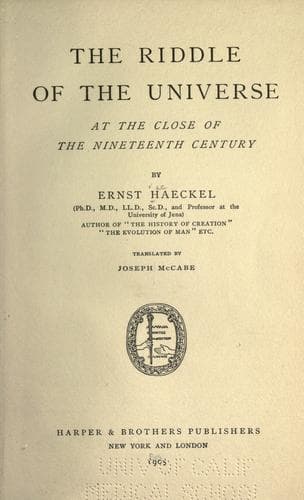
The Riddle of the Universe at the close of the nineteenth centuryHaeckel, Ernst
Religion
The Riddle of the Universe at the close of the nineteenth century
Haeckel, Ernst
Evolution; Monism; Religion and science; Soul
Since Kant explained space and time to be merely "forms of
perception"--space the form of external, time of internal,
sensitivity--there has been a keen controversy, which still continues,
over this important problem. A large section of modern metaphysicians
have persuaded themselves that this "critical fact" possesses a great
importance as the starting-point of "a purely idealist theory of
knowledge," and that, consequently, the natural opinion of the ordinary
healthy mind as to the _reality_ of time and space is swept aside. This
narrow and ultra-idealist conception of time and space has become a
prolific source of error. It overlooks the fact that Kant only touched
one side of the problem, the _subjective_ side, in that theory, and
recognized the equal validity of its _objective_ side. "Time and
space," he said, "have empirical reality, but transcendental ideality."
Our modern monism is quite compatible with this thesis of Kant's,
but not with the one-sided exaggeration of the subjective aspect of
the problem; the latter leads logically to the absurd idealism that
culminates in Berkeley's thesis, "Bodies are but ideas; their essence
is in their perception." The thesis should be read thus: "Bodies are
only ideas for my personal consciousness; their existence is just
as real as that of my organs of thought, the ganglionic cells in
the gray bed of my brain, which receive the impress of bodies on my
sense-organs and form those ideas by association of the impressions." It
is just as easy to doubt or to deny the reality of my own consciousness
as to doubt that of time and space. In the delirium of fever, in
hallucinations, in dreams, and in double-consciousness, I take ideas
to be true which are merely fancies. I mistake my own personality for
another (_vide_ p. 185); Descartes' famous _Cogito ergo sum_ applies no
longer. On the other hand, the reality of time and space is now fully
established by that expansion of our philosophy which we owe to the
law of substance and to our monistic cosmogony. When we have happily
got rid of the untenable idea of "empty space," there remains as the
infinite "space-filling"-medium matter, in its two forms of ether and
mass. So also we find a "time-filling" event in the eternal movement,
or genetic energy, which reveals itself in the uninterrupted evolution
of substance, in the _perpetuum mobile_ of the universe.
Public-domain text, read in full here on John Shaqi.
Reviews
Reviews
No reviews yet
Be the first to share your thoughts on this work.
Elsewhere in the archive
Join the Discussion
Join the discussion
Sign in to leave a comment or review.
Sign InorCreate an account