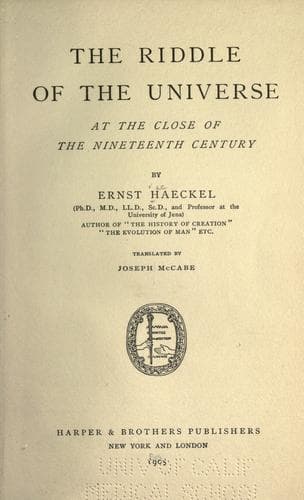
The Riddle of the Universe at the close of the nineteenth centuryHaeckel, Ernst
Religion
The Riddle of the Universe at the close of the nineteenth century
Haeckel, Ernst
Evolution; Monism; Religion and science; Soul
As a body which has been set in motion continues to move as long as no
external agency interferes with it, the idea was conceived long ago of
constructing an apparatus which should illustrate perpetual motion. The
fact was overlooked that every movement meets with external impediments
and gradually ceases, unless a new impetus is given to it from without
and a new force is introduced to counteract the impediments. Thus, for
instance, a pendulum would swing backward and forward for an eternity
at the same speed if the resistance of the atmosphere and the friction
at the point it hangs from did not gradually deprive it of the
mechanical kinetic energy of its motion and convert it into heat. We
have to furnish it with fresh mechanical energy by a spring (or, as in
the pendulum-clock, by the drag of a weight). Hence it is impossible to
construct a machine that would produce, without external aid, a surplus
of energy by which it could keep itself going. Every attempt to make
such a _perpetuum mobile_ must necessarily fail; the discovery of the
law of substance showed, in addition, the theoretical impossibility of
it.
The case is different, however, when we turn to the world at large, the
boundless universe that is in eternal movement. The infinite matter,
which fills it objectively, is what we call _space_ in our subjective
impression of it; _time_ is our subjective conception of its eternal
movement, which is, objectively, a periodic, cyclic evolution. These
two "forms of perception" teach us the infinity and eternity of the
universe. That is, moreover, equal to saying that the universe itself
is a _perpetuum mobile_. This infinite and eternal "machine of the
universe" sustains itself in eternal and uninterrupted movement,
because every impediment is compensated by an "equivalence of energy,"
and the unlimited sum of kinetic and potential energy remains always
the same. The law of the persistence of force proves also that the idea
of a _perpetuum mobile_ is just as applicable to, and as significant
for, the cosmos as a whole as it is impossible for the isolated action
of any part of it. Hence the theory of _entropy_ is likewise untenable.
Public-domain text, read in full here on John Shaqi.
Reviews
Reviews
No reviews yet
Be the first to share your thoughts on this work.
Elsewhere in the archive
Join the Discussion
Join the discussion
Sign in to leave a comment or review.
Sign InorCreate an account